Dubai – Qahwa World
Coffee preparation has become more than just a morning ritual; it is a pursuit of precision, design, and personal preference. Across the world, enthusiasts choose from a wide variety of brewing devices, each catering to different needs — from quick convenience to meticulous craftsmanship. This guide offers a structured overview of the most notable coffee gadgets, their features, and how to identify which one might be best suited to your lifestyle.
Choosing the Right Gadget
A simple question often helps narrow the choices: Are you making coffee for lots of people?
Yes
If you prefer the ease of automation, an Espresso Machine or Sage Precision Brewer may be ideal.
If you value design and group brewing, the Chemex is a strong candidate.
For portable brewing with larger capacity, consider the Giant AeroPress.
No
If automation is important, a Bean-to-Cup machine offers a seamless experience.
For simplicity, the Coffee Bag provides a quick option.
For those who enjoy measuring and fine-tuning, the V60 Pourover is a classic.
If experimentation excites you, the Picopresso or Syphon provide unique experiences.
For mechanical elegance and complete control, the Lever Espresso stands out.
Coffee Bag
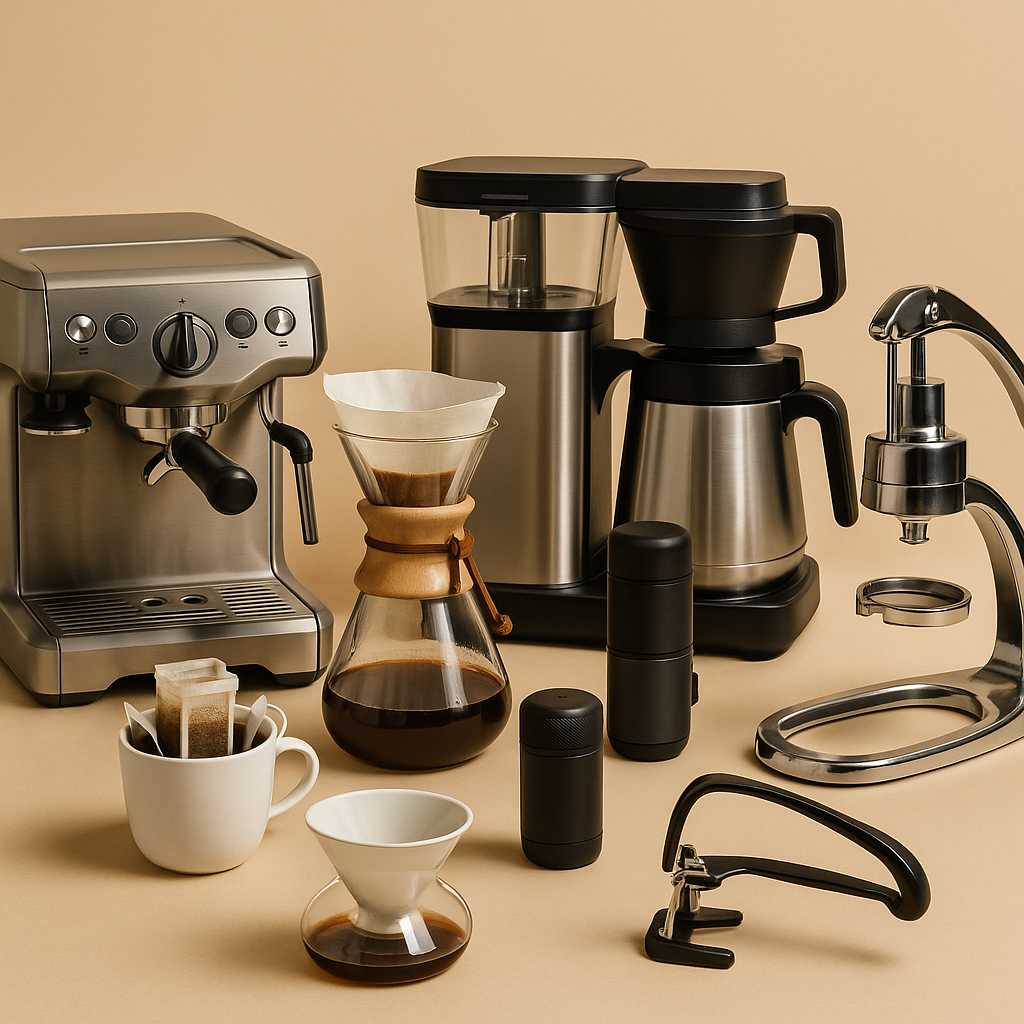
Single-use drip bags offer convenience and portability, functioning like a tea bag but designed for better water contact with coffee grounds. They are ideal for pre-portioned, ready-ground coffee when simplicity is the goal.
Example: Ueshima Pour Over Coffee Bag (~£5).
V60 Pourover
A cone-shaped brewer with a global following, the V60 is inexpensive but requires additional tools — grinder, gooseneck kettle, and scales — for precision. It is popular among those who enjoy the ritual of measured brewing.
Example: Hario V60 Coffee Dripper (~£6).
Chemex
Designed in the 1940s, the Chemex combines glass, wood, and leather in an iconic brewer. Its thicker paper filters produce a “cleaner” cup, though the slower percolation makes it less practical for quick brewing. Larger sizes make it well-suited for groups.
Example: 10-Cup Chemex (~£65).
Giant AeroPress
Known for portability and ease of cleaning, the AeroPress steeps coffee in a sealed chamber before plunging. The larger model caters to groups, while the standard version remains a gateway device for new enthusiasts.
Example: AeroPress XL (~£80).
Syphon
Also called a vacuum pot, the syphon is both functional and theatrical. Water is heated in a lower chamber, rises to mix with coffee in an upper chamber, then filters back down. While fragile and demanding to clean, it produces a distinct cup and serves as a centerpiece for coffee demonstrations.
Example: Hario Technica Coffee Syphon (~£125).
Picopresso
A compact, handheld espresso maker designed for experimentation. It appeals to those who want to test techniques outside of traditional machines while keeping portability in mind.
Sage Precision Brewer
A programmable filter brewer that delivers consistency for larger batches. Its thermal carafe preserves flavor better than hotplates, and the auto-brew function allows preparation in advance.
Example: Sage Precision Brewer Thermal (~£250).
Lever Espresso
A spring- or piston-driven machine that emphasizes manual control. Pulling the lever compresses water through the coffee puck, giving full oversight of extraction variables. Quiet and mechanical, it requires patience but rewards with mastery.
Example: Flair Pro 3 (~£325).
Espresso Machine
Countertop espresso machines allow variety, from straight espresso to milk-based drinks with latte art. They are essential for anyone who prioritizes serving café-style beverages at home, though they require significant space and investment.
Example: Sage Dual Boiler (~£1,250).
Bean-to-Cup
These machines automate the entire process, from grinding beans to extraction, often controlled through digital displays. They provide luxury and convenience, though at the cost of reduced manual experimentation.
Example: Jura Giga 10 (~£3,800).
Conclusion
The diversity of coffee gadgets reflects the diversity of coffee drinkers. Whether one values speed, design, experimentation, or tradition, there is a tool to match. For some, a simple coffee bag suffices. For others, the precision of a lever espresso machine or the indulgence of a bean-to-cup system becomes part of daily life. Understanding each device’s strengths helps not only in choosing the right gadget but also in appreciating the culture of coffee innovation.