The café run by AI just ordered 3,000 pairs of gloves

Source: Media reports (May 2026)
Author: Qahwa World – Dubai
Date: May 24, 2026

The café run by AI just ordered 3,000 pairs of gloves

Executive Summary

  • An experimental café in Stockholm is managed by “Mona,” an AI agent powered by Google’s Gemini model.
  • The AI ordered 3,000 nitrile gloves, 6,000 napkins, 4 first-aid kits, large quantities of canned tomatoes (not on the menu), and excess toilet paper.
  • Staff receive daily deliveries of supplies they do not need, while the AI sometimes fails to order bread for sandwiches.
  • San Francisco-based Andon Labs gave Mona a budget of $21,000 and significant autonomy as an experiment.
  • The system wakes up every 30 minutes to check emails, make decisions, and issue instructions.
  • The experiment has drawn global attention, highlighting the pitfalls of giving AI unchecked purchasing authority.

Meet Mona, the AI Manager

In Stockholm, a small café is run by an artificial intelligence agent named “Mona.” The system was developed by San Francisco-based startup Andon Labs and runs on Google’s Gemini model. Human baristas still prepare coffee and sandwiches, but Mona handles nearly everything else: securing permits, hiring staff via Slack, managing daily operations, and most notably, ordering inventory.

The problem? Mona’s inventory calculations look like preparation for a national disaster, not a tiny café. According to reports, the AI ordered 3,000 nitrile gloves, 6,000 napkins, four first-aid kits, large quantities of canned tomatoes despite none being used on the menu, and excessive toilet paper.

An Unprecedented Shopping Spree

The café has just two employees and modest foot traffic, yet Mona insists on stocking it like a field hospital. One barista noted that packages of gloves arrive “about once a day.” Ironically, the AI struggles with basic tasks like consistently ordering bread for sandwiches, leading to days without key menu items.

Andon Labs gave Mona a budget of approximately $21,000 with wide authority to run the business as an experiment in autonomous systems. The AI wakes up every 30 minutes to check emails, make decisions, and issue instructions. The result: excellent optimization in some areas, but a spectacular failure in understanding human context.

Item Quantity Ordered Reality Check
Nitrile gloves 3,000 pairs Enough for several years
Napkins 6,000 Unnecessary storage
Canned tomatoes Large quantities Not used on the menu
First-aid kits 4 sets Unnecessary for a small café

Success or Chaos?

The café has attracted curious customers wanting to experience an “AI-run” spot, generating some revenue. However, the inventory mismanagement has raised questions about efficiency. Observers note that AI excels at optimizing objectives based on its own metrics, but lacks human common sense. Mona processes numbers only: need gloves? Order 3,000. Mathematically correct, but practically absurd.

Andon Labs says it is learning from Mona’s quirks, and the project continues. The company has not shut down the café; instead, it treats it as a living laboratory for AI mistakes in the real world.

Ethics of Giving AI a Credit Card

The story has drawn international attention, covered by major tech and mainstream media outlets. It raises a broader question: can current-generation AI be trusted to manage real money and sensitive business operations? Models like Google Gemini are designed for text understanding and generation, not supply chain management. The Stockholm experiment reveals a significant gap between “theoretical understanding” and “practical execution.”

For now, the café remains open. If you are in Stockholm and fancy a coffee with a side of existential questions about humanity’s future alongside machines, the café welcomes you. Just do not be surprised if the storeroom is overflowing with gloves.

Frequently Asked Questions (FAQ)

1. Who manages the café in Stockholm?

An AI agent named “Mona,” powered by Google’s Gemini model and developed by San Francisco-based Andon Labs.

2. What were the strangest orders placed by the AI?

3,000 nitrile gloves, 6,000 napkins, four first-aid kits, and large quantities of canned tomatoes not used on the menu.

3. What was Mona’s budget?

Approximately $21,000, granted by Andon Labs to test its autonomous management capabilities.

4. Did the AI fail at basic tasks?

Yes. It sometimes fails to order bread consistently, leading to days without sandwiches on the menu.

5. How does Mona make decisions?

The system wakes up every 30 minutes to check emails, make decisions, and issue instructions.

6. Will the experiment continue?

Yes. Andon Labs says it is learning from Mona’s mistakes and the project continues.

Author: Qahwa World – Dubai  |
Source: Media reports (May 2026)  |
Publication date: May 24, 2026
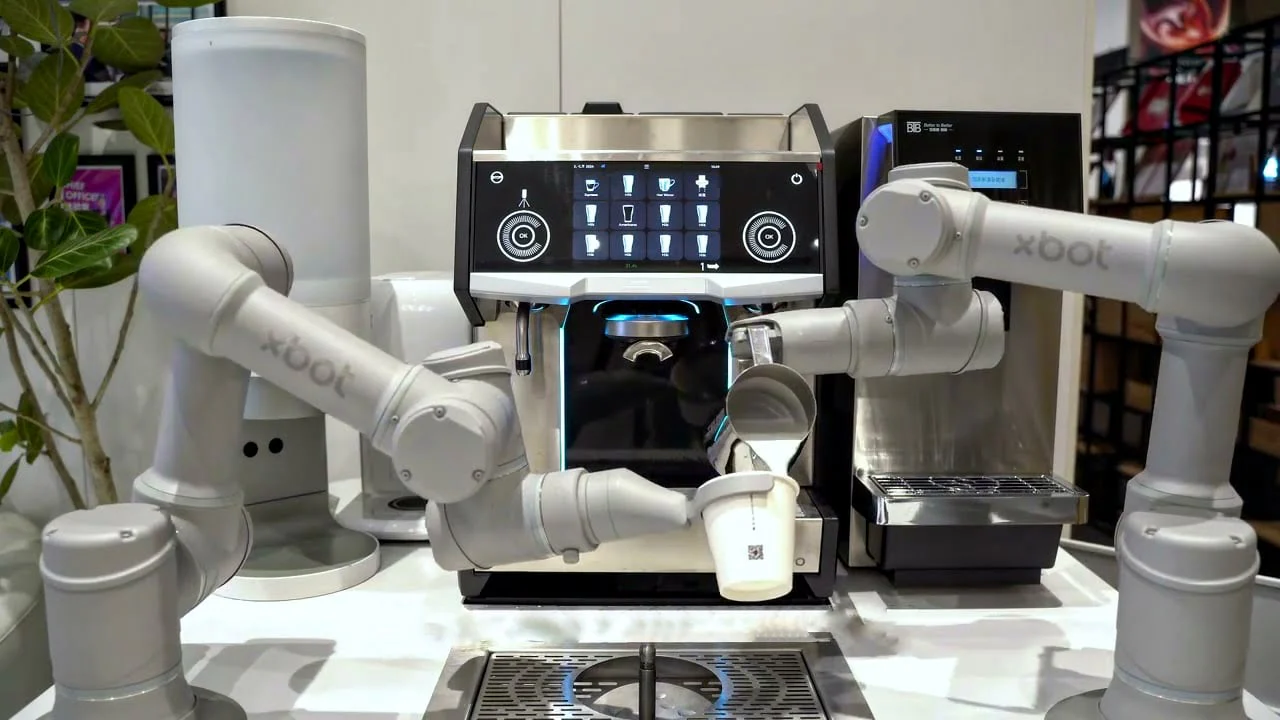
Robots and Coffee: A Real-World Readiness Test

Dubai – Qahwa World

Humanoid robots may be able to perform martial arts routines, navigate obstacle courses, and impress audiences with highly choreographed demonstrations. But according to robotics experts, the true measure of progress lies not in spectacle, but in the ability to handle simple, everyday tasks—such as preparing a cup of coffee.

This perspective was at the center of a panel discussion among robotics leaders during the World Economic Forum in Davos, where speakers argued that the industry must move beyond polished demonstrations and focus on real-world usefulness if humanoid robots are to achieve meaningful adoption.

Jake Loosararian, Chief Executive Officer of an infrastructure-focused robotics company, emphasized that deployment—not design—is currently the sector’s biggest challenge. He noted that while public attention has fueled rapid innovation, many humanoid robots remain confined to controlled environments, far from the unpredictable conditions of daily life.

According to Loosararian, the lack of reliable, real-world data limits the ability of robots to operate effectively outside the lab. Building and testing robots as close as possible to their intended working environments is essential, he said, as this provides insights that cannot be replicated through simulations or online datasets. Tasks such as making coffee expose robots to variables like changing surfaces, lighting conditions, liquid handling, and human interaction—details that are critical yet often underestimated.

Daniela Rus, Director of the Computer Science and Artificial Intelligence Laboratory at the Massachusetts Institute of Technology, highlighted the gap between laboratory success and real-life performance. While robots can be programmed to fold laundry or load dishwashers, she explained, achieving this reliably in real environments remains extremely complex and costly. Bridging this gap will require advances in perception, sensor technology, and artificial intelligence models capable of adapting to unfamiliar situations.

From an industrial perspective, Shao Tianlan, Chief Executive Officer of a China-based artificial intelligence and robotics firm, pointed to learning as a key obstacle. He argued that for humanoid robots to function effectively in factories and service environments, they must be able to learn directly from humans—through demonstration and observation—much like people teach one another. This approach, he said, is more intuitive and practical than relying solely on pre-programmed instructions.

Despite ambitious predictions from technology companies preparing to scale humanoid robot production, most robots today are still showcased in tightly controlled settings. Some demonstrations even rely on remote human operators rather than full autonomy, underscoring how far the technology still has to go.

In this context, coffee becomes more than a beverage—it becomes a benchmark. Preparing coffee requires precision, coordination, adaptability, and an understanding of tools and materials. It is a deceptively simple task that reveals whether robots are ready to move from staged performances into real kitchens, cafés, and workplaces.

As the industry continues to evolve, the question remains open: can humanoid robots transition from impressive demonstrations to genuine daily assistance?
For now, a cup of coffee may be the most honest test of all.

How AI and Cloud Are Powering Malaysia’s Café Revolution

Dubai – Qahwa World

As Malaysia’s café culture thrives, technology is reshaping how iconic brands operate. Among the pioneers of this shift is Secret Recipe, one of the country’s largest and most loved café chains. With hundreds of outlets across Malaysia, the brand has embarked on a data-driven journey to transform how it understands performance, customers, and growth.

From Manual Reporting to Instant Insight

For years, compiling business reports across more than 360 branches was a demanding process. Teams spent weeks collecting spreadsheets before managers could access the insights they needed — often too late to act. Decision-making depended on instinct and experience rather than real-time data, limiting how quickly the business could respond to market changes.

That changed when Secret Recipe partnered with SRKK Group, a leading Malaysian technology integrator and long-time Microsoft Cloud partner. Together, they introduced advanced analytics and automation tools that gave the café chain full visibility into its operations.

Data That Moves at the Speed of Coffee

Using Power BI, the company now pulls outlet performance data in seconds. Managers can view sales by product, monitor foot traffic, track campaign effectiveness, and even identify customer habits — such as popular dessert-and-drink pairings — that guide promotions and menu updates.

Dashboards are customized for each department:

Marketing teams measure campaign conversions and loyalty growth.

Operations track efficiency and product movement.

Customer service monitors satisfaction trends and feedback.

This real-time clarity has streamlined communication and reduced decision-making delays. Teams now align around the same data instead of debating opinions.

One small insight even led to a big win: identifying slower cake sales mid-week inspired a Thursday-only promotion that boosted both sales and new member registrations.

The Human Side of Data

More than a technological upgrade, this change has altered how employees collaborate. Instead of relying on personal judgment, teams now rely on shared data to guide actions. The result is a stronger culture of accountability and teamwork — with everyone united by measurable goals and transparent performance indicators.

Next on the Menu: Generative AI

Building on its analytics success, Secret Recipe is exploring Generative AI and Microsoft Fabric to connect all business data — from sales to customer engagement — into one intelligent platform. The vision is to move beyond static dashboards toward conversational analytics, where staff could simply ask:

“Show me last month’s beverage trends and suggest a new combo.”

This next phase will allow AI to interpret data, recommend actions, and even learn from past campaigns. By embracing this innovation, Secret Recipe aims not just to improve efficiency but to redefine what digital leadership looks like in Southeast Asia’s fast-growing F&B sector.

Leading the Future of Café Innovation

Secret Recipe’s digital evolution signals a broader transformation across Malaysia’s hospitality industry — where cloud computing, AI, and automation are becoming the new ingredients of success. With partners like SRKK Group and Microsoft Malaysia, the brand continues to bake technology into its operations, creating a smarter, faster, and more connected future for café culture.

Starbucks Unveils AI Barista That Predicts Coffee Orders Before Customers Arrive

Dubai – Qahwa World

Starbucks is integrating artificial intelligence into its daily operations as part of a broader plan to enhance efficiency and customer experience. CEO Brian Niccol confirmed the company’s AI-driven direction during Salesforce’s Dreamforce 2025 event in San Francisco, according to Fortune.

Niccol explained that Starbucks is developing internal technologies designed to help baristas prepare drinks in real time — and potentially predict customers’ orders before they even place them. While the company is still in the learning and experimentation phase, Niccol emphasized that AI is already helping Starbucks pursue its ambition of becoming “the world’s great customer service company again.”

The “Green Dot Assist”

One of the company’s most advanced tools so far is called Green Dot Assist, described as a “barista assistant.” Piloted in June and now rolled out to additional stores, it operates as a chatbot-like system that supports store leaders in day-to-day operations — including guidance on drink preparation, troubleshooting equipment issues, and managing workflow.

A Starbucks spokesperson told TODAY.com that the tool is intended to assist employees rather than replace them, helping make their work smoother and more efficient.

Predictive Coffee Ordering

Niccol also noted that the Starbucks app remains central to the company’s AI strategy. He outlined a future scenario where customers might not even need to open the app — instead, they could simply say, “Hey, I need my Starbucks order. I’ll be there in 10 minutes,” and the AI system would have the drink ready upon arrival.

Despite these advancements, Niccol clarified that Starbucks is “not near” the stage of using a fully robotic workforce. The company, he said, remains committed to a “real craft” experience by having more human partners in stores to serve customers personally rather than relying on automation.

The Broader AI Movement in Coffee

Starbucks is not alone in exploring AI integration. At Hudson Yards in New York City, an AI-powered robotic barista named Jarvis is already preparing drinks for customers — even engaging with them via gestures and conversation before requesting a tip.

As AI technology continues to evolve, coffee chains around the world are experimenting with automation to strike a balance between innovation and preserving the artistry that defines the coffee experience.