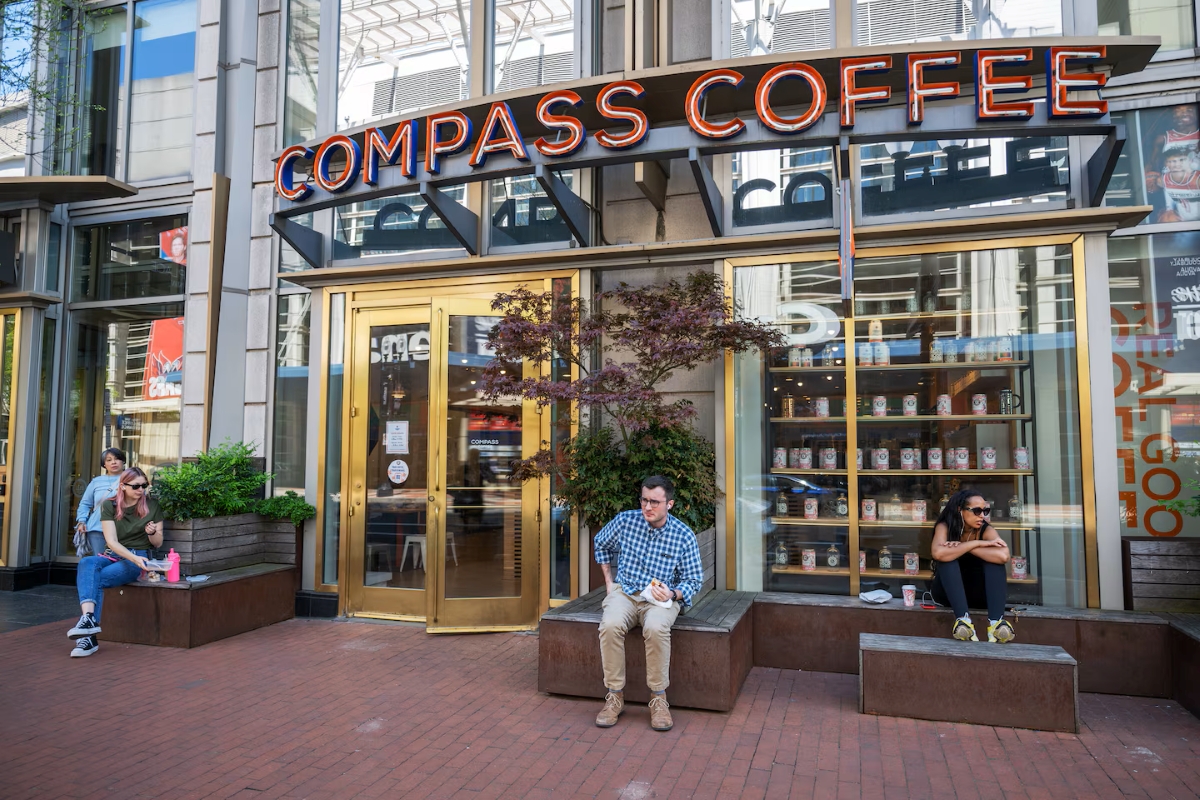
Caffè Nero Acquires Compass Coffee Assets in Bankruptcy Auction

DUBAI – QAHWA WORLD

U.K.-based coffee company Caffè Nero has secured the winning bid to acquire the majority of assets belonging to Washington, D.C.-based Compass Coffee, which filed for Chapter 11 bankruptcy protection last month.

The final bid reached $4.75 million following a competitive, three-day auction involving five prospective buyers. Caffè Nero had initially set the baseline offer at $2.9 million through a “stalking-horse” bid. The transaction remains subject to approval by the bankruptcy court.

Operations to Continue Under Compass Name

For now, the 17 Compass cafés operating across the D.C. area are expected to remain open under their current brand. Whether the Compass name will be retained long term has not yet been determined.

Compass co-founder and CEO Michael Haft stated in an interview with The Washington Post that representatives from Nero will begin meeting with Compass staff as part of the transition process. While Nero has indicated interest in keeping the existing leadership team, formal employment offers have not yet been finalised.

A court hearing is scheduled for February 26, the earliest date on which Nero could formally assume control of the company.

Background on Both Companies

Founded in 1997 by Gerry Ford, Caffè Nero has grown into an international brand with more than 1,000 locations across 11 countries. In the United States, however, its presence remains concentrated primarily in the Boston area, with no current locations in Washington, D.C.

Compass Coffee was established in 2014 by former Marine Corps officers Michael Haft and Harrison Suarez. The company expanded rapidly in its early years, focusing heavily on high-traffic downtown locations. It also invested substantially in a large roasting and production facility in Ivy City, aiming to scale its operations.

Financial Struggles and Bankruptcy

Despite its early growth, Compass struggled to achieve sustained profitability. The pandemic forced temporary closures of several downtown cafés and prompted the company to diversify revenue streams, including selling packaged coffee through grocery stores and direct-to-consumer channels, as well as producing hand sanitiser during the height of demand.

In recent years, additional pressures compounded the company’s financial strain. These included rising coffee costs, wage increases, reduced downtown foot traffic, a shrinking federal workforce, legal disputes with landlords and suppliers, and internal conflict between the founders. Suarez departed the company in 2021, and litigation between the co-founders followed.

By early January, Compass filed for Chapter 11 protection.

The $4.75 million sale will not cover all outstanding obligations. Total debts exceed $12 million, with secured creditors expected to recover approximately $2 million. Unsecured creditors remain owed several million dollars, and investors—including the founders—are not expected to recoup their contributions.

Looking Ahead

In a message to employees, Haft expressed optimism about the transition, suggesting that new ownership could provide stability in a market environment that has shifted significantly since 2020. He noted that downtown business patterns and consumer habits have changed, requiring a different operational approach than in the company’s early years.

If approved, the acquisition will mark the end of Compass Coffee’s 12-year period as an independent, founder-led company and signal Caffè Nero’s entry into the Washington, D.C., market.

Tariffs Push U.S. Coffee Industry Into Crisis as Prices Surge

Dubai, September 2, 2025 – (Qahwa World) – The U.S. coffee sector is entering one of its most turbulent phases in decades as new tariffs take hold, global prices soar, and supply chains face renewed disruption. From small roasters to household-name brands, the entire industry is scrambling to cope with higher costs and mounting uncertainty — with consumers ultimately left paying the price.

Prices Climb to Record Highs

According to the latest inflation data, the average retail price of roasted coffee in the U.S. has risen 14.8% since July 2024. In total, coffee prices have jumped 84% since 2021, with the retail price of ground coffee reaching $8.41 per pound in July 2025, up from $4.56 just four years ago.

Globally, the situation is even more alarming. Coffee prices have surged 59% year-over-year, with a 34% spike in August alone. Arabica stockpiles have fallen to less than 14.5 months of supply, the lowest level in a decade, driving specialty coffee prices above $20 for a 12-ounce bag in many U.S. grocery stores.

New Tariffs Reshape the Market

On August 6, the Trump administration imposed a sweeping set of tariffs: 50% on unroasted Brazilian coffee, 10% on imports from Colombia and Ethiopia, 25% on India, and 40% on Myanmar. Mexico remains the only major origin exempt, thanks to the U.S.–Mexico–Canada Agreement (USMCA).

Brazil — the world’s largest producer, responsible for 37% of global supply — is the hardest hit. With its price advantage wiped out, many U.S. roasters are reconsidering long-term sourcing strategies.

China and the European Union are moving quickly to fill the gap. In late August, Beijing approved 183 Brazilian exporters to ship coffee under a new five-year deal, while the EU, which already sources about a third of its coffee from Brazil, has secured additional contracts. These moves could permanently shift trade flows away from the U.S. market.

Roasters and Consumers Under Pressure

The tariffs are squeezing the entire coffee supply chain. Large corporations such as Starbucks and Keurig Dr Pepper can leverage economies of scale, but thousands of smaller roasters are struggling to absorb the shock.

Independent businesses like Elevated Roast in Washington State report tariff costs amounting to 21% of total imports. The owner says he is “eating” half the costs to shield customers, but acknowledges this approach is unsustainable in the long run.

Industry experts warn that roasters operating on thin margins — especially those with existing debt — may face closures if costs continue to rise alongside higher interest rates and restricted access to credit.

Consumers, meanwhile, are being forced to adapt. Coffee remains the most consumed beverage in the U.S., with 66% of adults drinking it daily, according to the National Coffee Association. Yet surveys show changing habits: many households are stockpiling coffee, trading down to cheaper brands, or reducing café visits. At the same time, 71% of Americans report brewing at home at least once a day, compared to just 16% who exclusively rely on cafés.

Political, Legal, and Climate Uncertainty

The tariffs have also sparked political and legal battles. Members of the Congressional Coffee Caucus have called on the administration to exempt coffee imports, arguing that every $1 spent on imported coffee generates $43 in economic value across the U.S. supply chain.

Legal challenges are already under way. A federal appeals court recently ruled that the administration exceeded its authority in imposing the tariffs, but enforcement remains suspended until at least mid-October pending possible Supreme Court review.

At the same time, climate change continues to amplify supply risks. Successive droughts in Brazil and Central America have already reduced yields, and any additional shocks could push prices even higher.

What Lies Ahead

Analysts agree that unless coffee is granted a tariff exemption, volatility will persist. While major players such as Keurig Dr Pepper and JDE Peet’s are pursuing a merger that could bring long-term efficiencies, such strategies will not address immediate disruptions.

The risk, experts warn, is a wave of consolidation in which small and mid-sized roasters exit the market, reducing diversity and competition while leaving the sector more dependent on a few corporate giants.

For consumers, the dilemma remains simple yet unavoidable: adapt to higher prices, change consumption patterns, or cut back altogether. But with coffee entrenched as both a ritual and a cultural staple, scaling back may prove harder than any trade policy shift.