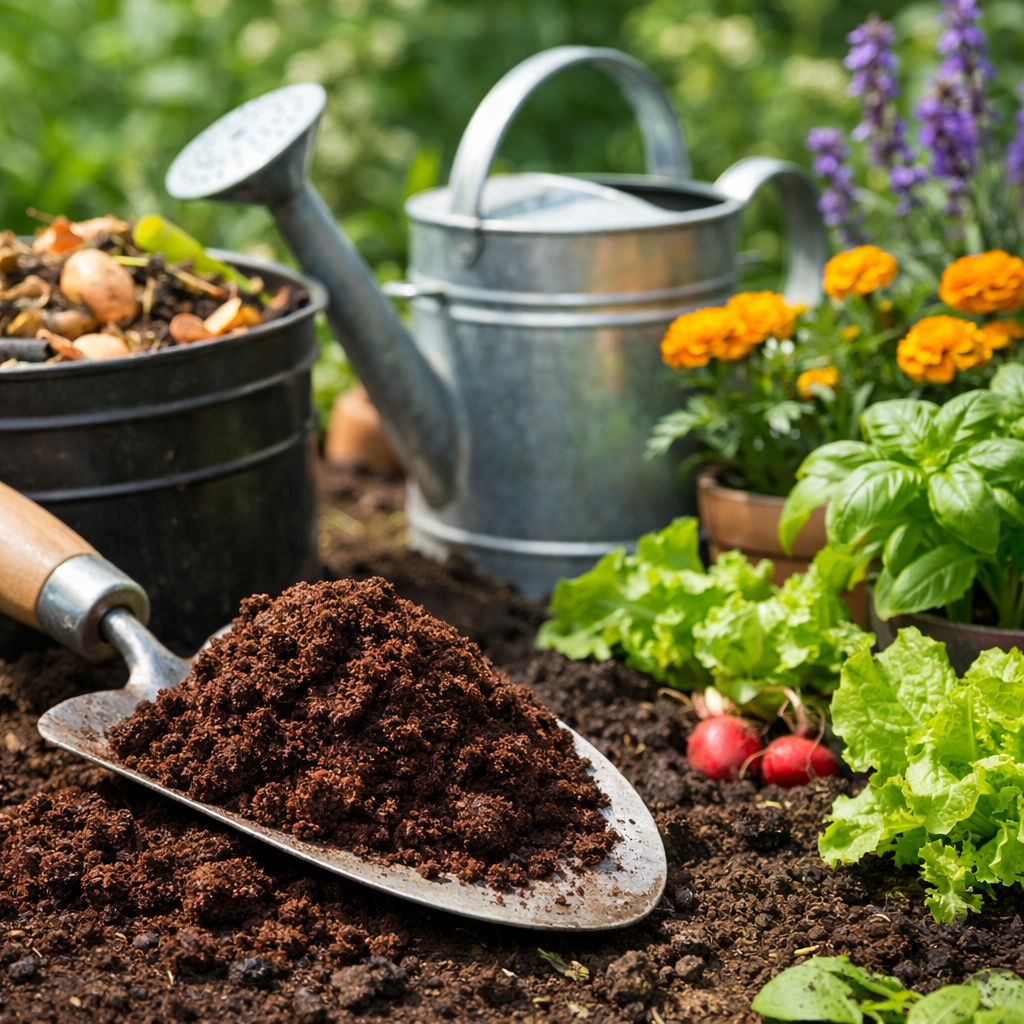
Coffee Grounds for Plants: Benefits and Risks for Your Garden

Dubai – Qahwa World

Using leftover brewed coffee or spent coffee grounds has long been a familiar practice among gardeners looking for simple, sustainable ways to improve their soil. Research from institutions including Oregon State University, Washington State University, and the University of Missouri, along with findings from peer-reviewed studies published in recent years, indicates that coffee residues can benefit plants—mainly when used as part of compost or as a soil amendment. Experts, however, stress that coffee grounds should not be considered a complete fertilizer.

  • Coffee Grounds Provide Several Plant Nutrients

Spent coffee grounds contain a number of nutrients useful for plant growth, though generally in modest quantities.

Nitrogen is the most significant component, typically accounting for about one to two percent of the grounds by weight. Most of this nitrogen is organic and bound in proteins, which means it becomes available slowly as soil microbes break down the material. Nitrogen plays an essential role in plant development, supporting protein formation and leafy growth.

You may Like: Coffee Grounds Can Strengthen Concrete by 30%: Australian Researchers Unlock Sustainable Building Breakthrough

Coffee grounds also contain potassium, which helps regulate water balance, supports photosynthesis, and assists with nutrient movement within plants. Smaller amounts of magnesium and copper are present as well, along with trace minerals such as iron, manganese, zinc, boron, and calcium. Magnesium is particularly important because it is a central component of chlorophyll, the pigment that allows plants to convert sunlight into energy.

  • Minor amounts of phosphorus and calcium are also found in the grounds.

By contrast, the liquid left after brewing coffee contains much smaller nutrient concentrations because most solids remain in the grounds. Laboratory analyses conducted through 2025 indicate that the overall nutrient profile of coffee grounds has remained consistent, although compost mixtures that include coffee residues can show higher total nitrogen levels.

  • Soil Microbes Are the Real Beneficiaries

Researchers note that the primary benefit of coffee grounds in gardening comes from how they affect soil biology.

The organic carbon in coffee grounds provides an energy source for soil microorganisms. As these microbes break down the material, they produce humus-like substances that improve soil health. These changes can lead to better soil structure, improved water retention, and enhanced drainage.

Microbial activity can also make certain nutrients—such as phosphorus, iron, and zinc—more accessible to plants, particularly in alkaline soils. In addition, organic matter produced during decomposition may help bind certain chemicals and heavy metals in soil, reducing the risk of runoff.

Read also: Center for Circular Economy in Coffee Launches Global Survey on Spent Coffee Grounds Valorization

Recent studies continue to explore these effects. A 2025 experiment involving sunflower plants found that composted coffee grounds incorporated into soil mixtures improved germination rates and plant growth compared with untreated soil. Another trial conducted in the United Arab Emirates in 2024 reported improved radish growth and soil quality when recycled coffee-ground fertilizer was used.

  • A Possible Tool Against Slugs

Coffee may also play a limited role in pest control.

Experiments suggest that solutions containing caffeine can repel or kill slugs and snails. In laboratory tests, strong brewed coffee solutions caused these pests to leave treated areas and eventually die due to the toxic effects of caffeine.

Some gardeners also report reduced slug activity when coffee grounds are used as a surface dressing or mulch. However, researchers say evidence remains limited, and there is little scientific support for claims that coffee grounds repel cats, eliminate weeds, or control plant diseases in gardens.

  • Risks of Using Too Much Coffee in Soil

Despite its potential advantages, coffee residues can create problems if used improperly.

One of the most common misconceptions is that coffee grounds act as a complete fertilizer. In reality, they contain relatively low levels of phosphorus and calcium, and the nitrogen they provide becomes available slowly. During decomposition, microbes may temporarily use nitrogen from the soil, which can reduce the amount available to plants.

Another misunderstanding involves soil acidity. Although brewed coffee is acidic, used coffee grounds are generally close to neutral in pH. Because of this, they usually do not significantly acidify soil.

Read also: New study: coffee grounds may be beneficial for brain health

When applied in thick layers, coffee grounds can also compact and form a dense surface crust. This barrier can restrict water infiltration and limit air movement into the soil, potentially harming plant roots.

Fresh grounds may also slow seed germination or inhibit early plant growth. Compounds such as caffeine and certain plant chemicals present in raw grounds can be harmful to seedlings when used in large quantities.

Finally, leftover coffee containing milk or sugar may attract pests or encourage unwanted microbial growth.

  • How Experts Recommend Using Coffee Grounds

Garden specialists generally recommend composting coffee grounds before adding them to soil.

A balanced compost mixture might include leaves, grass clippings, and coffee grounds, with the grounds making up no more than about one-fifth of the total volume. When regularly turned and properly maintained, the compost typically becomes usable within several months.

Coffee grounds can also be incorporated directly into soil in small amounts. Mixing a thin layer into the top few inches of soil is generally considered safe. When used as mulch, the layer should remain very thin and ideally be covered with coarser organic materials such as leaves or bark to prevent compaction.

Leftover brewed coffee can sometimes be used as a diluted watering solution after it has cooled, though gardeners typically dilute it with water to reduce its strength.

  • A Useful Resource—When Used Wisely

Research suggests that coffee grounds can contribute to healthier soil when used carefully. They add organic matter, support microbial life, and may provide limited pest-repelling effects. At the same time, experts caution that excessive use can cause more problems than benefits.

For gardeners, the best approach is to treat coffee grounds as a supplementary soil amendment rather than a primary fertiliser—ideally as part of compost and combined with other proven soil-improvement practices.

Invisible Microbes: Shaping Coffee, Soil & Health

By: Dr. Steffen Schwarz

We are instinctively drawn to what we can see. A ripening coffee cherry that blushes from green to red. A glossy crema that signals freshness. A rust lesion that alarms us because it is visible proof that something is wrong. Yet the most decisive actors in coffee, in agriculture, and even in our own bodies are neither red nor glossy nor easily photographed. They are everywhere and they are mostly invisible.

Microbes are not a footnote to life; they are the operating system. They are the chemistry department, the security service, the recycling authority and, when conditions allow, the saboteurs. The paradox is that the more fundamental their role, the less our minds register their presence. We do not wake up grateful for the bacteria that helped us digest last night’s meal, or for the fungi that keep pathogens in check, or for the unseen communities in soil that decide whether coffee roots can afford to grow deep, to flower, to carry fruit, and to fill seed cells with the precursors that later become aroma.

We notice microbes when they frighten us: infections, mould, spoilage, toxins, off-notes. But the story of microbes is not primarily a story of threat. It is a story of protection and possibility, and coffee is one of the most compelling stages on which this story plays out.

Consider, for a moment, the human body as a coffee farm. It has roots (our gut lining), pathways (blood vessels), a protective canopy (skin and mucosal surfaces), and a constant flow of nutrients. Now imagine trying to run that farm as a sterile monoculture. You would quickly discover that sterility is not the same as health.

On our skin and in our digestive tract, lactic acid bacteria help create a low-pH, competitive environment that makes it difficult for many unwanted organisms to establish themselves. They are, in a very literal sense, an invisible inner and outer shield. Their protective effect does not come from heroism, but from metabolism: they consume available nutrients, occupy space, produce organic acids and other inhibitory compounds, and communicate with our immune system in ways that shape how aggressively we respond to real danger.

In the same way, the coffee plant is not a solitary organism standing against the world. It is a holobiont: a living consortium in which the plant’s physiology and the microbiome’s chemistry co-produce resilience. When that consortium is diverse and well-fed, the plant often behaves as if it has more options. When it is impoverished, the plant behaves as if it is constantly paying interest on ecological debt.

This is why the discovery of antibiotics was not merely a triumph of medicine; it was an insight into microbial ecology. Penicillin did not arrive as an alien weapon—it was a fungal strategy in a microscopic war over resources. Microbes have been inventing chemical solutions to competition for billions of years, and we have merely learned to borrow some of them.

In coffee production, a similar borrowing is underway, sometimes consciously and often accidentally. We borrow microbial enzymes to break down mucilage, microbial acids to steer fermentation, microbial antagonism to suppress plant disease, and microbial symbioses to mobilise nutrients that would otherwise remain locked in soil minerals. The question for coffee decision-makers is no longer whether microbes matter. It is whether we are willing to manage them with the same seriousness with which we manage varieties, shade, irrigation, logistics, and roasting curves.

To understand what microbes do for coffee, it helps to divide their world into two connected theatres: the living plant in its soil, and the harvested fruit in its processing environment.

In the field, microbes occupy the rhizosphere (the narrow, intensely active zone around roots), the surfaces of plant tissues (the episphere), and the interior of the plant (the endosphere). This is not microbiological trivia; it is functional geography. Roots release exudates—sugars, amino acids, organic acids, and signalling molecules—that act like a targeted investment portfolio. The plant spends carbon to recruit allies. In return, certain bacteria and fungi enhance nutrient uptake, produce phytohormones, suppress pathogens, and improve tolerance to stress.

A coffee farm is therefore also a microbial habitat-engineering project, whether the manager intends it or not.

Research across gradients of management intensification shows that soil microbial community composition often shifts more strongly with management category than with geography. Managed plots tend to show lower soil moisture, lower pH, altered nitrogen and phosphorus patterns, and an increasing C:N ratio. More revealing than chemistry alone is biology: the cast of microbial characters changes even when overall diversity appears similar.

This matters because nutrient cycling is a microbial business. Nitrogen fixation, organic matter mineralisation, phosphorus mobilisation, and carbon turnover all depend on microbial metabolism. When soils acidify under long-term management pressure, enzyme activity shifts, carbon processing changes, and nutrient availability becomes less predictable. From the cup’s perspective, these changes influence precursor formation long before fermentation begins. Coffee flavour is not only post-harvest artistry; it is the downstream expression of upstream microbial economics.

Among the most underappreciated allies are arbuscular mycorrhizal fungi, which extend the plant’s effective foraging area through fungal hyphae that transport water and nutrients in exchange for carbon. These living logistics networks are shaped by agricultural practices, with more ecologically managed systems often supporting richer and more resilient mycorrhizal communities.

Similarly, plant growth-promoting rhizobacteria solubilise phosphate, fix nitrogen, produce hormone-like compounds, and contribute to induced systemic resistance. Yet their application remains limited, partly because microbes are context-sensitive. A strain that thrives in a trial may fail in a field whose pH, moisture, and microbial competition do not support it. The inoculant is only as effective as the habitat built for it.

If the field is one theatre, post-harvest processing is the other. Here, microbes finally step into the spotlight. Coffee fermentation is the managed decomposition of fruit material around a seed. Microorganisms degrade mucilage and produce organic acids, alcohols, and other metabolites that influence sensory outcomes.

Lactic acid bacteria deserve special attention. Much like in the human body, their production of lactic acid lowers pH, suppresses undesirable organisms, and shapes microbial succession. Their influence is not merely “acidity,” but chemistry: enzyme activity, compound diffusion, and microbial competition all respond to pH. Under well-managed conditions, lactic acid bacteria can contribute to cleaner fermentations and structured flavour profiles. Under unmanaged conditions, the same invisibility can become a liability, allowing spoilage pathways or safety risks to emerge.

This is why starter cultures matter. A starter culture is a decision to replace uncertainty with intention. But success depends on ecosystem design: temperature, oxygen availability, hygiene, water quality, and cherry integrity all determine whether a culture becomes a conductor or merely another instrument in a loud orchestra.

Fermentation is not a recipe. It is a living system with feedback loops. Microbes are its sensors and actuators.

When we connect both theatres—field and processing—the picture becomes clear. The microbial community on the cherry does not begin in the tank. It begins in the soil. Soil management shapes plant nutrition; plant nutrition shapes fruit chemistry; fruit chemistry shapes fermentation; fermentation shapes roasting behaviour and cup expression. The cup is a microbial narrative written in chapters.

For quality managers, producers, roasters, and buyers, this means one thing: microbial management is a strategic lever. In the field, organic matter inputs, shade systems, erosion control, and pH stewardship select microbial partners. In processing, hygiene is population control, temperature is succession management, and water quality is a selective pressure.

The invisible is not optional. Microbes will always participate. The only question is whether they participate as allies or as uncontrolled variables.

The most advanced coffee operations of the future will not be those chasing novelty, but those translating applied science into repeatable microbial stewardship—quietly, credibly, and precisely. By finally taking the invisible seriously, we may produce coffees that are more expressive, more consistent, and more sustainable—because we stopped trying to manage coffee without managing life’s smallest majority.