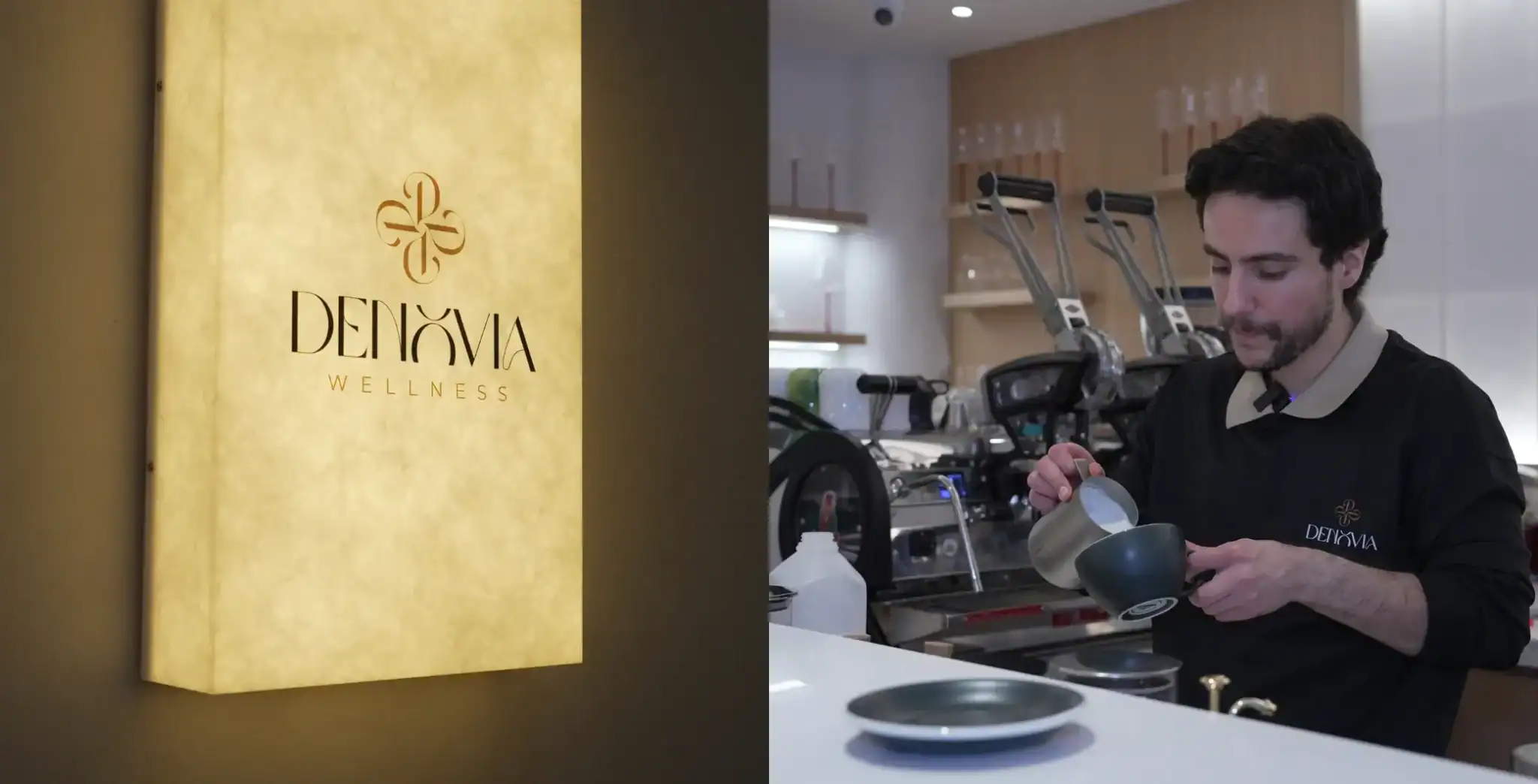
Toronto Café Serves $99 Coffee as Part of a Wellness Experience

Toronto – Qahwa World

A new café in Toronto’s Midtown is challenging traditional ideas of a coffee break by offering one of the city’s most expensive cups of coffee — alongside yoga sessions, sound therapy, and wellness treatments.

Denovia, a recently opened wellness-focused café, is serving a Panamanian Elida Geisha hand brew priced at $99 per cup. The coffee is produced in extremely limited quantities, with only 50 cups available per supply, positioning it among the most exclusive specialty coffees currently offered in Toronto.

The café’s founder, Nick Wang, describes Denovia as a hybrid space combining specialty coffee with wellness practices. While the ground floor operates as a café serving both rare beans and familiar drinks such as cappuccinos and cold brews, the upper levels are dedicated to wellness services. These include yoga, aromatherapy, sound therapy, sports recovery treatments, and IV drips.

Wang said the concept was shaped by growing post-pandemic stress levels and personal exposure to wellness practices, noting that the space is intended to encourage calm, reflection, and slower consumption rather than rushed routines.

At the center of Denovia’s premium coffee offering is the Elida Geisha, a varietal originally traced to Ethiopia and later refined in Panama. The coffee is widely known for its floral and fruit-forward characteristics, often associated with notes such as jasmine, bergamot, stone fruit, and tea-like sweetness. Its profile contrasts sharply with the heavier, chocolate-driven flavors found in more conventional coffees.

Geisha coffee is also known for its demanding cultivation requirements. It is typically grown at elevations between 1,500 and 2,000 meters, in volcanic soil and highly specific microclimates that include cool temperatures, mist, and stable weather conditions. These constraints significantly limit supply.

According to Wang, beans from the Elida estate have achieved prices of approximately $1,029 per pound at international Best of Panama auctions, attracting buyers from the global specialty coffee market.

Beyond rarity and price, Wang emphasized the experience itself. He said the Geisha is meant to be enjoyed slowly, comparing it to tea culture rather than fast-paced coffee consumption. In his view, the drink is intended to encourage relaxation and creative thinking rather than speed.

While the $99 Geisha attracts the most attention, Denovia’s menu includes other specialty offerings at lower price points. Hand brews and pour-overs sourced from Ethiopia and Colombia begin at $28, including the ALO 74158. Another Geisha option, the Luna Geisha, is priced at $35. Standard menu items such as americanos and matcha lattes start at $6.

Denovia barista Alex Pinzon, who has eight years of experience in the coffee industry, said customers often question the pricing of high-end specialty coffees. He explained that these coffees undergo more careful processing and preparation, resulting in flavor profiles that surprise many first-time drinkers.

Pinzon noted that customers frequently assume fruit has been added to the coffee, only to learn that the flavors come naturally from the beans themselves.

Among the café’s other specialty drinks are the El Pariso Peach hand-brew latte, described as having a tea-like, peach-forward character, and the TOR8NTO — a sparkling coffee mocktail featuring lychee and strawberry notes.

Denovia is currently operating in a soft-opening phase, with its official grand opening scheduled for January 2026.
Panama Seeks Global Trademark for “Panama Geisha” as Record Auction Prices Spark New Push for Protection

Dubai – Qahwa World

Panama’s Specialty Coffee Association (SCAP) is taking formal steps to secure global branding and trademark rights for “Panama Geisha” following another historic year at the Best of Panama (BoP) auction. The move comes as gesha coffees continue to dominate both the quality rankings and international market prices.

At the August 2025 BoP auction, a washed Gesha coffee from Hacienda La Esmeralda in Boquete, Panama, set a new record at $30,204 per kilogram. The 20-kilogram lot, scoring 98.00 points from 22 international cupping judges, was purchased by Julith Coffee & Roastery in Dubai for a total of $604,080. Overall, the auctioned lots generated approximately $2.8 million, more than double the previous year’s total.

Out of 50 lots, 40 were gesha, reflecting the global demand for this premium variety. Although gesha originates from Ethiopia, the Panamanian cultivar has evolved into a distinct genetic line, renowned for its delicate floral aroma and complex cup profile.

Trademark Efforts

SCAP has accelerated its long-running effort to protect “Panama Geisha.” In September 2025, the association filed trademark applications for a figurative logo in the United States and United Kingdom, following earlier approvals in the European Union and Japan in 2022. Some Panamanian producers have already integrated the logo into packaging and trade show displays.

SCAP president Richardo Koyner states that the trademark will protect the authenticity and origin-linked value of Panamanian gesha, cultivated under unique conditions of volcanic soil, high altitude, diverse microclimates, and artisanal expertise.

Historical Auction Price Highlights

The rise in gesha’s market value is illustrated by previous auctions:

2017: top lot sold for $601/lb; total auction revenue $368,711.

2024: top lot sold for $4,542/lb; total revenue $1.38 million.

2025: top lot sold for $30,204/kg (20 kg, total $604,080) at the Best of Panama electronic auction.

The rapid growth in prices has also attracted counterfeit coffees, a challenge similar to Hawaii Kona or Jamaica Blue Mountain. Trademarking “Panama Geisha” is intended to counter misuse and preserve the integrity of the brand.

Trademark vs. Geographical Indication

SCAP is pursuing a stylized logo, not the term alone. Legal experts note that protecting a figurative mark is often more feasible than a geographic or descriptive term.

Other countries have used geographical indications (GI) for origin protection. For example, Colombia’s “Café de Colombia” and Mexico’s “Café Veracruz” and “Café Chiapas” are legally protected. Panamanian gesha qualifies for GI due to its unique qualities linked to local terroir and genetic distinctiveness, as confirmed by World Coffee Research.

However, SCAP chose the trademark approach because it is simpler, faster to enforce, and easier to license. Membership in SCAP, which currently exceeds 89 members, is required to use the trademark, even though Panama has over 8,200 coffee producers nationwide. Critics argue that broader protections like a GI could benefit all producers cultivating gesha.

Looking Ahead

While U.S. and U.K. trademark approvals are still pending, branding efforts are already enhancing the global prestige of Panama’s gesha. Combined with rising demand and auction performance, “Panama Geisha” is likely to remain one of the world’s most celebrated and high-value coffees for years to come.