2022 AEROPRESS CHAMPIONSHIP TO TAKE PLACE IN OCTOBER

UAE AeroPress Championship, the UAE’s largest coffee championship, returns in 2022 for sixth edition. Winners will stand a chance to compete in the 2022 World AeroPress Championship finals in Vancouver, Canada in December. 2022 UAE Championships in October will be hosted by DMCC Coffee Centre for third time.

For the sixth year running, the 2022 UAE AeroPress Championship kicks off with the Regional Championships, followed by the National Championship, which will take place October 3rd, 4th and 5th, 2022, at the DMCC Almas Conference Centre, Almas Tower, Jumeirah Lake Towers, in Dubai. This year’s edition will be attended for the first time ever by the creator of the World AeroPress Championship and coffee industry luminary, Tim Williams.

Come to watch and support the best baristas and coffee enthusiasts in the UAE as they compete for a spot on the ultimate world coffee stage – the 2022 World AeroPress Championship in December in Vancouver, Canada.

For the third time in the competition’s history, DMCC Coffee Centre will play host, bringing the UAE coffee community together for the 2022 iteration. Ahmed Bin Sulayem, Executive Chairman and Chief Executive Officer, DMCC, said: “We are thrilled to host the UAE AeroPress Championship yet again, a competition which brings together the very best baristas and the most passionate coffee enthusiasts from across the UAE to DMCC. The DMCC Coffee Centre’s state-of-the-art facilities offer world-class infrastructure and services, so we are perfectly set up to not only host global coffee events but also position Dubai at the heart of the international coffee supply chain.”

This year’s AeroPress Competition will also be the first under the direction and support of the recently appointed Director of Agri Commodities and Head of DMCC Coffee Centre, Mr Saeed Al-Suwaidi. Of this year’s event, he said: “I am excited to be working alongside some of the world’s leading coffee experts to host the UAE AeroPress Championship. I am very much looking forward to recognising the best baristas and sampling the best cup of coffee made by an AeroPress at the end of this championship.”

Tim Williams, the CEO, Owner, and Chief Organizer of the World AeroPress Championship and the founder of Melbourne’s Fieldwork Coffee will be in attendance and assuming the responsibilities of Head Judge for the first time in the region. Since the early 2000s, Tim has worked across a range of roles, including Workshop Coffee and Square Mile Coffee Roasters in London and Intelligentsia Coffee & Tea in Los Angeles. Tim says about the UAE competition, “I’m really happy to be able to make it to the UAE AeroPress Championship for the first time. Like the World AeroPress Championship itself, our event in Dubai continues to grow in popularity and reach, so it’s wonderful to be able to attend and see the action first-hand.”

The organiser of the event and CEO of Mokha 1450, Garfield Kerr, adds, “We are very excited for the sixth annual UAE AeroPress Championship event and quite pleased that Tim Williams will be in attendance. It is difficult to make the biggest coffee competition in the UAE more exciting each successive year; however, with the event graciously hosted for the first time at DMCC’s iconic Almas Tower, as well as the attendance of Tim Williams, we have succeeded. We’re also delighted to fulfil our event’s main mandate in bringing together the incredibly diverse UAE coffee community under one roof for this exciting event that has become a favourite of baristas, café owners, and the general public alike.”


Russian doctor: coffee is useful for most patients

Deputy Minister of Health of the Chelyabinsk region Dmitry Tarasov shared with his subscribers in social networks new data about the popular drink. Scientists have found that coffee is useful for most patients.

According to Dmitry Tarasov, experts have been observing for 10 years how coffee consumption affects the heart: rhythm disturbances, ischemic disease, heart failure, stroke and life expectancy in general.

It turned out that regular coffee consumption is safe and can be part of a healthy diet, including for people with heart disease.

“As in any case, there is a but! Before using it, you should consult with your doctor. It is important to observe the dosage,” Dmitry Tarasov, Deputy of the Ministry of Health of the Chelyabinsk Region, commented on the scientists’ research.

In those who drink one cup of coffee a day, the risk of premature death from various diseases was reduced by 20% compared to those who completely refused coffee.

“It is also noted that drinking two or three cups a day reduced the risk of coronary heart disease, arrhythmia, and heart failure by 10-15%,” Dmitry Tarasov writes on his VKontakte page.

The Deputy Minister of Health of the region advises to listen to doctors. If your doctor advises you to stop drinking coffee, then this is most likely due to an individual reaction to the drink. So, its uncontrolled use can cause discomfort, for example, anxiety and palpitations.

Florence coffee bar customer calls police over price of espresso

A coffee bar in Florence has been fined €1,000 (£846) after a customer got steamed up over the price of a humble cup of espresso.

The customer called police after being charged €2 (£1.70) for his coffee – a decaffeinated one, at that – at Ditta Artigianale in the centre of the Tuscan city.

The man complained that the price was not displayed on a menu behind the counter. It was this error that landed the bar, which is celebrated for its coffee-making and has won winning several competitions, in trouble.

Francesco Sanapo, the owner of Ditta Artigianale, vented about the fine on social media and defended his coffee, which he said comes from a small plantation in Mexico and “is prepared with great care by my baristas”. He argued that the price of the coffee was displayed on a digital menu.
“They fined me because somebody got offended for paying €2 for a decaffeinated coffee [which involves a water extraction process]. Can you believe it?” Sanapo said in a video while holding up a letter from the police. “Even today, someone can get so annoyed that they mobilise the police, who find us to be in the wrong due to an outdated law. This law must be changed because otherwise 99.9% of bars and restaurants would easily fall foul of it.”

In Italy, the average cost of an espresso is €1, although more than 70% of bars increased prices earlier in the year due to supply chain issues and poor harvests. Consumer groups warned that the price of an espresso could rise to an average €1.50 this year.

Sanapo said that Ditta Artigianale – described on Facebook as the “first Italian coffee bar dedicated to quality coffee” – was somewhat “revolutionary” when it charged €1.50 for an espresso when the bar first opened in 2013. “There was negative and positive reaction, but until now I had never been fined,” he said. “Nobody should be scandalised about paying €2 for an espresso any more,” he added, citing the rise in cost of raw materials.

The Florence branch of Confartigianato, an association for small businesses, defended the bar. “This is something that deeply embitters me,” its president, Alessandro Vittorio Sorani, said. “A great deal of work goes into producing a quality product. Quality pays off and benefits everyone.”

Some of the bar’s customers leaped to its defence too. “If this customer went to London he’d get the FBI involved,” one wrote on Facebook.

… as you’re joining us today from the UAE, we have a small favour to ask. Tens of millions have placed their trust in the Guardian’s fearless journalism since we started publishing 200 years ago, turning to us in moments of crisis, uncertainty, solidarity and hope. More than 1.5 million supporters, from 180 countries, now power us financially – keeping us open to all, and fiercely independent.

Unlike many others, the Guardian has no shareholders and no billionaire owner. Just the determination and passion to deliver high-impact global reporting, always free from commercial or political influence. Reporting like this is vital for democracy, for fairness and to demand better from the powerful.

And we provide all this for free, for everyone to read. We do this because we believe in information equality. Greater numbers of people can keep track of the global events shaping our world, understand their impact on people and communities, and become inspired to take meaningful action. Millions can benefit from open access to quality, truthful news, regardless of their ability to pay for it.

Drinking coffee after eating is harmful to health

A Russian nutritionist warned against drinking coffee immediately after eating.
According to Sputnik Radio, nutritionist Natalia nefedova recommended drinking coffee more than 30 minutes after a meal .
The specialist said that drinking coffee during or immediately after meals disrupts the process of assimilation of macro-and microelements.

She added that if you constantly drink coffee with food, the body will receive less zinc, iron and magnesium.

In addition, coffee is able to remove calcium from the body, so it is better to drink it with milk or with a piece of cheese. Stressing that it is important to remember that milk adds extra calories to the drink.

Saudi PIF launches Saudi Coffee Company

Saudi Arabia’s sovereign wealth fund said it launched a coffee company to develop the national industry, boost production capacity and promote Saudi coffee beans as a global product, in line with the kingdom’s focus on the priority sector of food and agriculture.

The new Saudi Coffee Company, in partnership with the private sector, will support the kingdom’s coffee industry along its entire value chain, from bean to cup, the Public Investment Fund (PIF) said in a statement on Sunday.

It will also play a “vital role” in developing sustainable coffee production in the southern Jazan region, home to the coffee Arabica, the fund said.

“The launch of the Saudi Coffee Company aligns with PIF’s strategy, which focuses on developing and enabling 13 promising sectors, including food and agriculture, as part of broader efforts to diversify sources of income for the local economy,” it said.

The Saudi Coffee Company plans over the next 10 years to invest nearly 1.2 billion Saudi riyals ($320m) in the national coffee industry, with the goal of boosting the country’s production from 300 tonnes per year to 2,500 tonnes per year.

The company also aims to establish a dedicated academy to train local talent, entrepreneurs, coffee plantation owners and farmers as part of PIF’s focus on creating opportunities for small businesses and start-ups, the fund said.

It will also introduce the latest technologies across the planting, harvesting, roasting and marketing aspects of the coffee industry in Saudi Arabia.

The dedicated academy will open in various locations in the country, where Saudi Arabian professionals, entrepreneurs, coffee plantation owners and farmers can get training and knowledge to help them start their own businesses.

The academy will also help locals in the region to contribute to the industry’s growth and benefit from the opportunities that arise, the fund said.

An Indonesian company uses the Internet of Things to process coffee after harvest

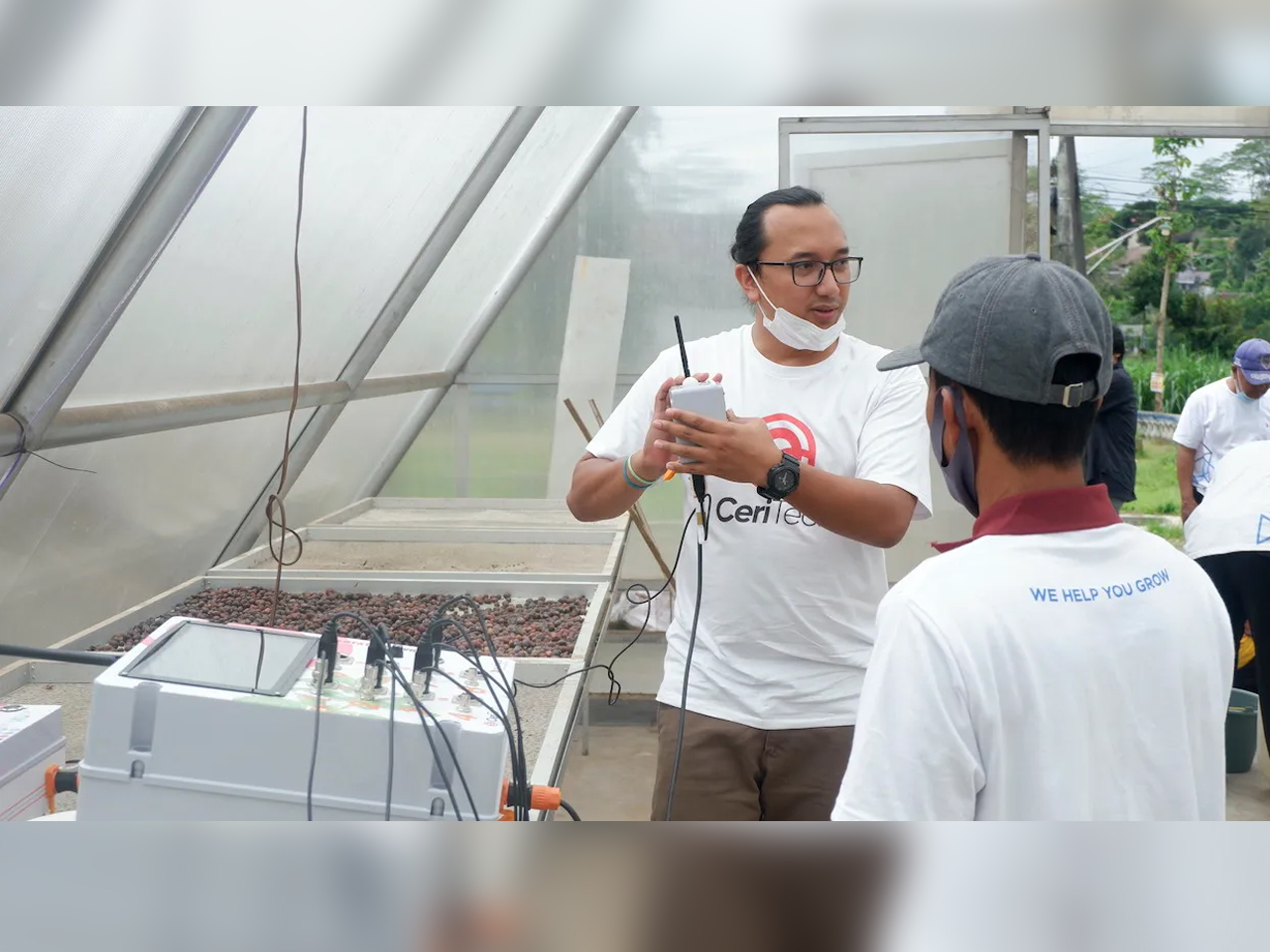
Indonesian startup Veritech Indonesia has rolled out Veritech IoT, a cloud-connected system designed to assist coffee producers in the control of post-harvest processing.

The Bandung, Jawa Barat (West Java)-based company plans to follow up with a green coffee trading platform later this year and roast profiling software next year.

The new Veritech IoT hardware and software package is for monitoring and quality control in the post-harvest drying and fermentation phases.

The CeriTech IoT fermentation device.

In the drying phase, the CeriTech IoT electronic device records ambient temperature, humidity and light intensity, as well as the temperature of the fruit or parchment.

The device also connects directly to equipment such as exhaust fans or heaters, turning them on and off as needed to maintain conditions set by the user through the associated app.

In the fermentation phase, the device records pH levels and the ambient temperature.

Data is available through the mobile app real-time monitoring, while the app can alert users to deviations from pre-set parameters.

The CeriTech IoT drying device.

The technology arrives at a time when coffee producers throughout the world have turned to innovations and stricter controls of post-harvest processing protocols for both quality assurance and flavor development, particularly in the specialty arabica market.

Having tested the system with 10 coffee producers in the growing regions of Java and Aceh in Indonesia, CeriTech said it is preparing to commercialize CeriTech IoT through direct sales to larger producers.

The CeriTech IoT fermentation device.

The startup is also developing a B2B e-commerce platform for green coffees called CeriTech Trade Commerce, with plans to launch later this calendar year.

The company told Daily Coffee News that the prices for CeriTech IoT devices and apps sold to larger producers will be dependent upon the size of their harvests.

For smaller and medium-sized producers with more constrained budgets, the hardware and software will be leased at no cost, as long as those producers commit to selling their CeriTech-monitored products on the trade platform.

Sensors place in coffee at various stages of post-harvest processing relay conditions to users through the IoT device.

“We have a unique business model that does not require the producers/processors to buy or subscribe to the system directly,” Aldi Raharja, Co-Founder and CEO of CeriTech, told Daily Coffee News.

“Our models include the commodity trades and also financing models for the producers. In short, we require some of their products that produce with our devices to be sold on our platform.”

At the moment, the technology and platform is being rolled out only in the domestic market, although plans to expand are imminent.

“At this early stage, we focus on Indonesian producers,” Raharja told DCN, “but in terms of technological availability, we have already researched on how to bring the products globally, hopefully in the next year.”

Raharja, a former geophysicist and founder and roaster of Bandung-based coffee company Tri Tangtu Kopi, founded CeriTech in 2018 with a team of five other people, including hardware engineers Ahmad Radhy and Deny Viviantoro, software engineer Azmy Ansori, COO Rocky Martakusumah, and CMO Kristian Batafor.

The drying device.

The company also plans to launch a quality control and assessment tool for roasters called CeriTech Roaster in 2023. The roast profiling software would integrate with the IoT and trading platform services.

“We plan to sell Roaster to the small and medium enterprise roastery that is growing in Indonesia, and perhaps in the world,” said Raharja. “We are planning to develop tech-based solutions in every phase in the supply chain of coffee, so that we could make sure that the data could have a continuity of use and make a distribution of impact.”

Uganda Parliament Delays Decision on Coffee Exports Deal

The future of Uganda’s coffee sector and the 15 million people engaged in the crop’s value-chain remains unclear after the Deputy Speaker of Parliament declined the tabling and debate of a key report on the sector.

The document prepared by the House committee touched on the contentious agreement between the government and Italian investor Uganda Vinci Coffee Company Ltd.

But for the third time in a week, Deputy Speaker Thomas Tayebwa defied pressure from legislators to amend the order paper and allow the Trade Committee chairman Mwine Mpaka to table the report. On May 2, Mr Mpaka said the probe report into the Vinci coffee deal was ready and only awaited allocation of time on the order paper to table it before Parliament.

“The item will come,” Mr Tayebwa said. “I know the report is complete, but the presiding officer always has to read through the report [and] comprehend it so that they are able to moderate the matter once it is on the floor.”

Stirred up emotions
Mr Tayebwa was responding to Kira Municipality MP Ibrahim Ssemujju Nganda, who said the coffee agreement was “urgent” and “contentious”, and the report’s findings and recommendations should be given priority before the Speaker referred new business to the trade committee.
The report, which was signed by all 27 committee members, will be debated followed by a vote to decide whether to terminate the coffee deal or uphold it.

On February 10, Uganda government through Finance Minister Matia Kasaija and Permanent Secretary Ramathan Ggoobi, signed a deal with Vinci Coffee Company, represented by Enrica Pinetti.

The agreement gives Vinci Coffee Company a monopoly not only to buy, but also to set the price at which the coffee is supplied to it.

The deal also makes number of other concessions that have been roundly criticised by legislators and players in the coffee sector. These include a 10-year tax holiday and contributions to the National Social Security Fund, 25 acres of land at the Namanve industrial and business park to build a 60,000 tonnes per annum soluble coffee processing facility, which will start with 27,000 tonnes.

When it became public, the agreement stirred up emotions among players in the sector, which employs many Ugandans, including 12 million farmers, as well as traders and exporters that earn from the country’s leading crop export.

Tashkent hosts International Coffee and Tea Festival for the first time

From 13 May to 15 May, the Uzbek capital Tashkent will host the International Coffee and Tea Festival for the first time.

Tea and coffee lovers will be able to enjoy the competitions between coffee makers ” barista” and connoisseurs of tea rituals that will be held in the park near the blue domes.

The festival is organized by the barista Association of Uzbekistan with the aim of developing coffee and tea culture in Uzbekistan.

Visitors to the festival will have opportunities to taste different types of tea from around the world, take part in the tea ceremony and watch how professionals compete in tea brewing and in the “barista classic” and “latte art battle”tournaments.

On the sidelines of the festival will be held several lectures and lessons for the Republic in the presence of the guest of honor of the festival IRA Sharapova.

Also on the sidelines of the festival there will be a separate entertainment area for the arts of face painting and animation for children. In addition to yoga classes in the morning, DJ shows in the evening.

Coffee Supplies to Russia Decreased due to the situation in Ukraine

Coffee supplies to Russia have declined significantly due to the situation in Ukraine.

According to “Reuters”, supplies of coffee intended for the Russian market are redirected by suppliers and traders to other destinations. Some suppliers stopped selling altogether.

Although the food trade is not subject to sanctions, difficulties in processing payments from Russian importers and concerns about the safety of ships in the Black Sea have led to reduced supplies of coffee and other goods to Russia.

Russia is one of the world’s top five coffee importers.

Coffee prices in Russia have risen by more than 20 percent due to rising costs, according to broker hedgepoint. The situation in Ukraine has reduced demand by about 1.3 million 60-kilogram bags.

Alvin Lopez, commercial director of Honduran coffee exporter enloher, said he had been instructed by a partner of his company (French food trader Sucden) to redirect a batch of coffee bound from Honduras to Russia to the port of New York.

Saudis Spend $267 Million on Coffee

The spending of the Saudis on preparing coffee amounted to more than one billion riyals (about $267 million), with an increase of more than 80,000 tons, according to a report by “Sabq” newspaper.

This expenditure ranked the Kingdom as one of the most coffee consuming countries in the world, while the annual quantities of coffee imported to the Saudi market are estimated at about 73,000 tons.

The head of the Jazan Chamber of Saudi Arabia, Counselor Ahmed Abu Hadi, said that according to the latest official statistics, the domestic product of Arabica coffee in the mountainous governorates in the regions of Jazan, Al Baha and Asir amounted to 1,810 tons annually, and about 350 tons of pure coffee after peeling, and the number of coffee farms in them reached 2,535 farms, containing 398,000 coffee trees.

Abu Hadi pointed out that the volume of women’s investment is about 15% of the total market, and it is expected to grow to 32% within a few years, which also provides many job opportunities for young people, and specialized experts expect that by 2025 spending on coffee outside the home will reach about 70 %, with a compound annual growth rate between 18% and 32%.

And he indicated that, according to those economic estimates, the Jazan Chamber has worked on completing the study of establishing a coffee production factory in the Jazan region, with an investment capital estimated at 65.7 million riyals, and a production capacity of 1788 tons annually.

He pointed out that the project’s profitability indicators estimated the ROI at 538%, and the payback period is 3 years, adding that the study of the coffee project represented the 11th investment opportunity that the Chamber had completed its economic study.

UAE’s Booming Coffee Trade Shines at Expo 2020 Dubai

The UAE’s coffee industry is on a rapid growth trajectory, having reached a staggering AED 3 billion in trade last year. With substantial expansion anticipated this year, Expo 2020 Dubai is witnessing marketing campaigns from major global coffee producers. The UAE is capitalizing on opportunities in its thriving coffee market, where coffee is more than just a beverage – it’s a symbol of hospitality and an economic powerhouse.

The Dubai Coffee Centre, established in 2019, has catapulted the UAE into one of the most advanced coffee markets in the region. The coffee sector in the UAE, including the wider Middle East and Africa, is projected to grow by 7.5% until 2025.

Notable among the coffee producers is Colombia, a global leader in coffee production, particularly known for its high-quality Arabica beans. The country’s unique coffee processing and roasting methods create a distinctive flavor that is beloved by coffee enthusiasts worldwide. Colombian coffee’s impact on the economy is considerable, providing employment for numerous individuals.

Brazil, the world’s top coffee producer, is facing challenges due to climate change, with droughts threatening its coffee crop. The importance of coffee to Brazil is undeniable, and any disturbances in production can have far-reaching effects on global coffee markets.

Vietnam, the second-largest coffee producer globally, focuses on robusta beans, offering an alternative to the more expensive Arabica beans. The country is strategically aiming to double its annual coffee exports to $6 billion in the next decade.

Indonesia boasts some of the rarest and most expensive coffee varieties globally, including the coveted civet or Kopi Luwak. The country holds a significant share of the world’s coffee production.

Ethiopia, known for its full-flavored, robust coffee beans, has been increasingly successful in coffee trade. The country’s coffee industry has seen historic revenues and ambitious plans for growth.

Latvia has carved a niche in the coffee industry by importing and re-exporting coffee beans after roasting them to various grades, leveraging its geographical location and roasting expertise.

Yemen, renowned for producing high-quality Arabic coffee, is exploring coffee cultivation as a vital opportunity, with a goal to reach self-sufficiency.

Saudi Arabia is celebrating the “Year of Saudi Coffee,” showcasing its rich coffee culture at Expo 2020 Dubai. Efforts are underway to boost coffee production, with numerous model farms and developments in the southwestern regions of the kingdom.

The global coffee market is dynamic, with various countries contributing their unique flavors and approaches, making coffee more than just a beverage but an economic and cultural asset.

How Much Coffee You Need To Drink To Live Longer

Scientists have said how much coffee you need to drink to live longer

During the study, scientists were able to establish the exact number of cups of coffee that you need to drink daily to reduce the risk of premature death.

The experiment took place for 11 years, during which time scientists found that those who drank three cups of coffee every day had a 12% lower risk of premature death. There was also an association with the consumption of this volume of coffee and an improvement in overall health indicators. In particular, it was found that the people participating in the study had a 17% reduced risk of dying from heart disease and a 21% reduced risk of stroke.

One of the authors of the study, Dr. Pal Maurovich-Horvath, said that scientists used MRI to analyze the effect of regular coffee consumption on the structure and function of the heart. “We found that regular coffee consumption in moderation is good for heart health, and suggested that it may slow down its age-related changes,” he explained.