
WA Coffee Shops Seek New Sources for Beans as Trump Tariffs Begin

Coffee roasters in the Puget Sound area are preparing for rising costs following new tariffs on coffee imports. Many local coffee businesses, including those in Seattle—a city renowned for its coffee culture—are concerned about the impact of the tariff increases, particularly on beans imported from Latin America.

The U.S. Department of Agriculture reports that 80% of coffee beans imported into the U.S. come from Latin American countries, with Brazil and Colombia being significant suppliers. Both countries are now facing a 10% tariff hike, which is likely to drive up prices for local coffee roasters.

In response, some roasters are exploring alternative bean sources. A Tacoma coffee shop owner is even considering Puerto Rico and other U.S. territories to find more affordable options. However, the owner warned that if tariffs continue to rise, they may have no choice but to pass the higher costs onto consumers. While corner cafés may not experience the same impact as grocery store customers, price hikes could still affect local coffee drinkers.

Gabrielle Clune, a Seattle resident, expressed concern about the rising costs: “It’s very expensive already. I mean, like seven dollars for a cup. If the prices go up even more, I might just start getting my coffee from the office instead of the shop downstairs.”

In Quincy, The Pour Haus is also feeling the strain of the new tariffs. The owners, who source their coffee beans from Colombia and Guatemala, as well as liquor from Germany and Canada and syrup from France, are preparing for a potential increase in costs. However, they remain hopeful about keeping prices stable for their customers.

Jarid Jones, co-owner of The Pour Haus, said, “Our hope is to continue to maintain prices as they stand and we hope that if something does need to change, that customers will be responsive to that and understand what that looks like because again, it’s not something that we can control and it will be something that is even outside of our business and other businesses, and so we hope that customers will continue to support the local businesses.”

Under the proposed tariffs, import duties could rise up to 45% for coffee from Mexico and 10 to 15% for beans from Colombia, Honduras, and Guatemala. Jones noted that his business is already feeling the effects, particularly with the rising costs of coffee and liquor used in their popular espresso martinis.

“Certainly, imports are going to change what that cost looks like. We have noticed it already and our specialty is the espresso martinis, and that’s one of our biggest cocktail hour drinks. There are two combinations there, one for the liquor which has increased and then the combination of what we see for our beans as well,” Jones said.

As tariffs continue to affect local businesses, both coffee roasters and drink shops like The Pour Haus are facing an uncertain future, with both business owners and consumers awaiting the full impact of these price changes.
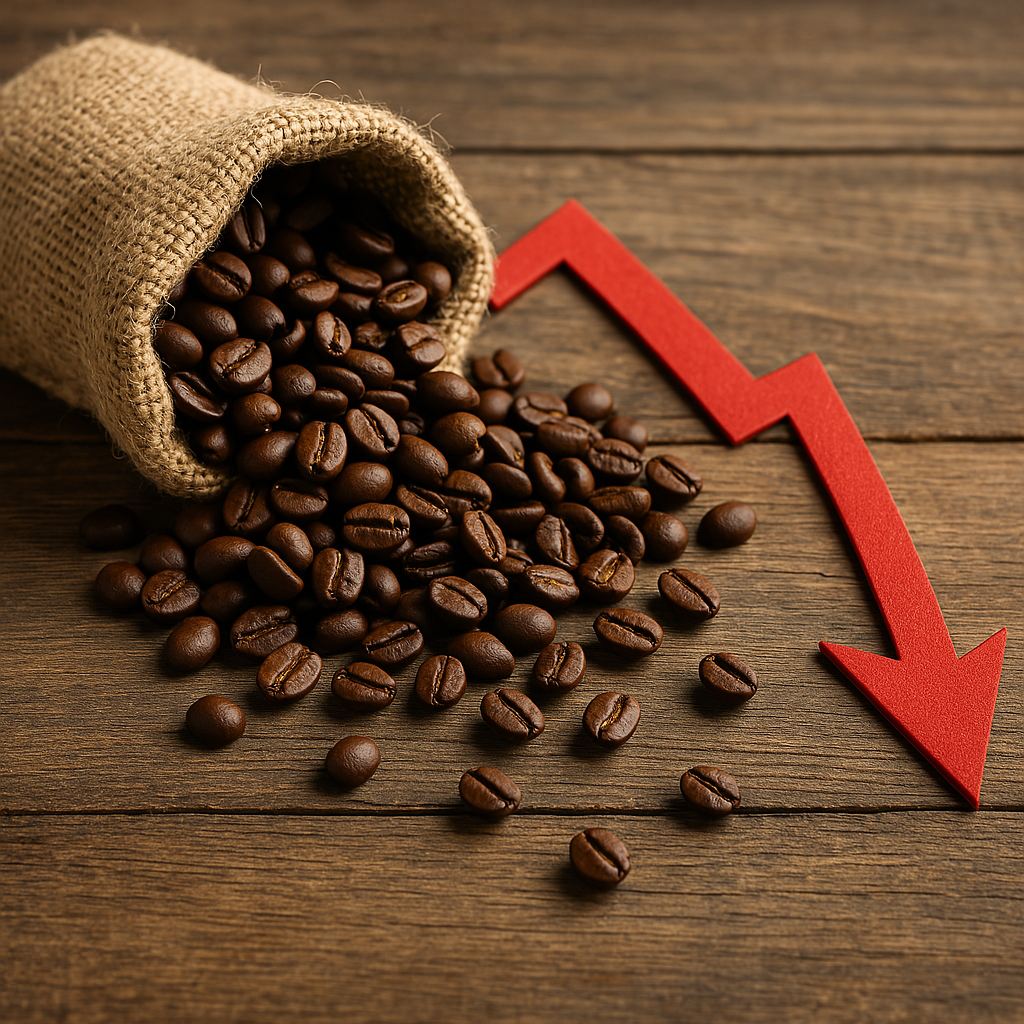

Nasdaq: Global Coffee Prices Tumble Amid Market Volatility and Export Pressure

Coffee prices saw a steep decline on Friday, with May Arabica contracts falling by 5.07% to reach a two-month low, and May Robusta down by 4.82%, hitting their lowest level in two and a half months. According to Nasdaq, the drop was driven by a widespread risk-off sentiment in global markets, which pressured most commodities, including coffee. Concerns are also mounting that rising tariffs could raise retail prices for consumers and dampen overall demand.

The Brazilian real weakened to a three-week low against the U.S. dollar, prompting increased export activity from Brazilian producers. As Nasdaq reported, this added further pressure to prices, especially for Arabica, as Brazil remains the world’s largest coffee exporter.

While previous fears over dry weather in Brazil have eased, long-term supply concerns remain. Somar Meteorologia recently reported that Brazil’s key Arabica-producing region of Minas Gerais received 31.1 mm of rain in the last week of March—114% of the historical average. Nonetheless, Brazil’s coffee export data points to tightening supply: Cecafé revealed a 12% year-over-year drop in February green coffee exports, totaling 3 million bags. Brazil’s official crop agency, Conab, also lowered its 2024 crop estimate to 54.2 million bags and projects a further decline to 51.81 million bags for the 2025/26 season, the lowest in three years.

ICE-monitored inventories reflect similar trends. Arabica stocks fell to a one-and-a-half-month low of 770,476 bags, while Robusta stocks dropped to a three-week low of 4,308 lots. Brazil’s largest Arabica cooperative, Cooxupé, has also warned that recent high temperatures and below-average rainfall may negatively impact this year’s yields.

The effects of last year’s El Niño are still being felt across Latin America. Brazil is reportedly experiencing its driest weather since 1981, affecting flowering and harvest potential for upcoming seasons. Colombia, the second-largest Arabica producer, continues to recover from drought conditions as well.

On the Robusta front, Vietnam is facing ongoing supply constraints. Its 2023/24 coffee production dropped by 20% to 1.472 million metric tons—the lowest level in four years—while exports in the first quarter of 2024 were down 15.3% year-over-year. The Vietnam Coffee and Cocoa Association recently lowered its 2024/25 production forecast from 28 million bags to 26.5 million. However, expectations for a rebound in 2025/26 persist, with Marex Solutions projecting Vietnam’s Robusta production to rise to 28.8 million bags, alongside a 13.6% increase in Brazil’s Robusta output to 25 million bags.

Marex Solutions also forecasts that the global coffee surplus will expand in the 2025/26 season to 1.2 million bags, up from 200,000 bags in 2024/25. Nevertheless, drought-linked revisions may tighten the outlook once again. Volcafe, following a crop tour, cut its 2025/26 Brazil Arabica forecast by nearly 11 million bags, projecting a total of 34.4 million. The firm also estimates an 8.5 million bag global Arabica deficit next season—the fifth consecutive year of deficit.

On the demand side, USDA’s Foreign Agriculture Service expects global coffee production to increase by 4% in 2024/25 to 174.86 million bags, split between a 1.5% rise in Arabica and a 7.5% rise in Robusta. Still, the report projects a 6.6% drop in ending stocks, bringing global reserves to a 25-year low of 20.87 million bags. The USDA also forecasts Brazil’s coffee inventories will fall to 1.2 million bags by the end of the 2024/25 season, down 26% year-over-year.

Global export figures remain mixed. Brazil’s coffee exports in 2024 rose 28.8% year-over-year to a record 50.5 million bags, according to Conab. Meanwhile, data from the International Coffee Organization showed global exports fell 12.4% in December and slipped 0.8% year-over-year in the October-to-December quarter.

Egg Coffee: A New Trend Blending Flavor and Wellness

A new and intriguing trend is making waves in the coffee world: egg coffee. This unusual beverage, inspired by an old Swedish brewing method, combines the rich aroma of coffee with the nutritional benefits of eggs — and it’s quickly gaining a devoted following, according to Sports.kz, citing Pravda.ru.

What’s the Secret Behind Egg Coffee?

The preparation of egg coffee is simple, yet surprisingly unconventional. A whole raw egg, including the shell, is mixed with ground coffee in a bowl. This mixture is then boiled over heat, and once it reaches a rolling boil, it’s strained through a fine sieve. The result is a clean, aromatic brew with a smooth flavor, free from the bitterness and tannins often found in traditional coffee.

Key benefits of this brewing method include:

  • A milder, less bitter flavor;

  • Removal of impurities often present in regular coffee;

  • A clean, full-bodied aroma.

Health Benefits Beyond Taste

Egg coffee isn’t just about flavor — it’s packed with nutrients that support overall health:

  • Rich in vitamins and minerals: Egg yolk is a natural source of vitamins A, E, D, K, and B-complex;

  • Supports fat metabolism: Choline in eggs helps protect the liver from fat accumulation;

  • Antioxidant protection: Lutein and zeaxanthin help guard liver cells against oxidative stress;

  • Cholesterol regulation: Regular consumption may help maintain healthy cholesterol levels;

  • Brain health: Caffeine boosts brain function, while the nutrients in eggs support cognitive performance.

Why Is Egg Coffee Gaining Popularity?

This Swedish-style coffee is turning heads thanks to its unique combination of flavor and function. It’s emerging as a perfect breakfast companion for those who value both taste and health benefits. As noted by Hungarian publication Kiskegyed, egg coffee is opening up new possibilities in the world of coffee traditions and could very well become the next big hit among adventurous coffee lovers.

Trump’s New Tariffs Threaten U.S. Coffee Imports

Sweeping new tariffs announced by President Donald Trump on April 2 may have a significant impact on the U.S. coffee market, according to data from the Foreign Agricultural Service (FAS) of the U.S. Department of Agriculture and the International Trade Administration (ITA).

During an afternoon press conference, President Trump unveiled a universal minimum tariff of 10% on all imported goods, including food and agricultural products. The 10% tariff will take effect on April 5, while additional country-specific tariffs will be implemented on April 9, according to White House officials.

The president presented a chart listing tariff rates for at least 50 countries, ranging from 10% on imports from the United Kingdom to 49% on imports from Cambodia.

Several of the countries listed are among the world’s largest coffee producers. As the top global importer and consumer of coffee, the U.S. could face significant supply chain challenges as a result.

According to 2024 FAS data, the leading coffee-producing countries and their new U.S. tariff rates are:

  1. Brazil (38% of global production) – 10%

  2. Vietnam (17%) – 46%

  3. Colombia (7%) – 10%

  4. Indonesia (6%) – 32%

  5. Ethiopia (5%) – 10%

  6. Uganda (4%) – 10%

  7. India (4%) – 26%

  8. Honduras (3%) – 10%

  9. Peru (2%) – 10%

  10. Mexico (2%) – 25%

Based on ITA data, the top 10 sources of U.S. coffee and coffee product imports by value in 2023 were:

  1. Colombia – $1.4 billion

  2. Brazil – $1.4 billion

  3. Switzerland – $1.1 billion (31% tariff)

  4. Canada – $568 million

  5. Honduras – $463 million

  6. Guatemala – $458 million (10% tariff)

  7. Mexico – $364 million (25% tariff)

  8. Nicaragua – $360 million (18% tariff)

  9. Vietnam – $347 million

  10. Indonesia – $269 million

Most coffee imports are not covered by tariff exemptions under the U.S.-Mexico-Canada Agreement (USMCA), meaning they are subject to the additional 25% tariffs President Trump has pledged to enforce against certain nations.

In March, the National Coffee Association (NCA) urged the White House to exempt coffee and coffee products from the proposed duties.

“Except for limited production in Hawaii, the United States has no domestic alternatives to imported coffee,” wrote Bill Murray, NCA president and CEO, in a letter to the Office of the U.S. Trade Representative. He emphasized that the coffee industry contributes over $340 billion annually to the U.S. economy.

Earlier this year, coffee prices rose sharply amid inflation and supply concerns, climbing to a wholesale high of over $4 per pound.

This is a developing story. Stay tuned to Food Business News for updates on how the new tariffs may reshape the food and beverage industry.

New Study Reveals What Your Favorite Coffee Says About Your Personality

A new psychological analysis suggests that your daily coffee choice may offer more than just a caffeine boost—it could be a window into your personality. From bold black coffee to carefully customized brews, researchers have found interesting links between preferred coffee types and certain character traits.

Clinical psychologist Dr. Ramani Durvasula conducted a study involving over 1,000 individuals to explore how food and beverage choices reflect personality dimensions. One of the most intriguing findings: the type of coffee you drink can mirror how you think, act, and relate to others.

Black coffee lovers tend to value simplicity and efficiency. They’re often traditional, disciplined, and straightforward, though they may resist change. Latte and cappuccino fans are warm and friendly, but can sometimes neglect their own needs while pleasing others.

Those who enjoy iced coffee are often seen as spontaneous and creative, enjoying life in the moment. However, their impulsive nature can sometimes lead to rash decisions. On the other hand, those who prefer highly customized or decaffeinated coffee often exhibit perfectionism and a need for control, balancing that with health-conscious habits.

Perhaps most notable are the consumers of specialty coffee—individuals who demonstrate a higher degree of self-awareness, ethical consideration, and appreciation for quality and craft. According to a study published in the journal Appetite, such coffee drinkers often have strong values around sustainability and social responsibility.

Although these findings are not absolute, they provide an intriguing perspective on how daily rituals like coffee drinking can reflect deeper psychological tendencies.

Coffee at Risk: U.S. Tariffs on Vietnam Threaten Higher Prices

The U.S. coffee market is bracing for potential price hikes following Washington’s decision to impose a 46% tariff on coffee imports from Vietnam — the world’s largest producer of robusta beans, which are widely used in instant coffee and low-cost espresso blends.

The new trade measure is expected to intensify existing supply chain pressures, as global coffee markets already grapple with tight inventories and rising costs. Robusta futures in London have surged by more than 40% over the past year, while arabica prices in New York remain high due to adverse weather conditions in key producing countries.

According to Priyanka Sakdeva, a senior analyst at Phillip Nova, the newly imposed tariffs will likely worsen market volatility and deepen the robusta supply shortage. She emphasized that the impact will be particularly felt in segments that rely on robusta for affordable coffee products. Replacing robusta with arabica, she noted, is not a viable solution due to the latter’s higher cost and different flavor profile.

Nguyen Nam Hai, Chairman of the Vietnam Coffee and Cocoa Association, expressed shock at the scale of the tariff and voiced serious concern about existing export contracts. He stressed that alternative suppliers such as Brazil, Indonesia, and Côte d’Ivoire would struggle to match both the volume and quality of Vietnamese coffee.

Analysts warn that U.S. importers will now face higher sourcing costs, which could trickle down to consumers through rising retail prices and reduced availability of budget-friendly options in cafés and grocery stores — all at a time when the global coffee industry is already under strain from climate, logistical, and economic challenges.

Trump’s Tariff Shockwaves Rattle Coffee, Cocoa, and Sugar Markets Worldwide

World markets for coffee, cocoa, and sugar saw notable declines on Wednesday, following a dramatic escalation in trade tensions sparked by U.S. President Donald Trump’s announcement of sweeping new import tariffs. Investors reacted with concern, fearing that higher costs would dampen demand for key soft commodities in the United States—one of the largest global consumers of chocolate and coffee products.

The latest trade measures include a 10% baseline tariff on all U.S. imports, with certain countries facing levies exceeding 50%. This move marks a sharp departure from decades of trade liberalization and sent ripples across global commodity markets, triggering sell-offs and heightened volatility.

Coffee markets were particularly impacted. Arabica coffee futures on the ICE exchange—a benchmark for global prices—fell 0.7% to $3.8605 per pound by 15:54 GMT, after dropping nearly 3% earlier in the day. Robusta coffee prices also weakened, slipping 0.1% to $5,393 per metric ton, following a steeper decline of 2.5% earlier.

Tariffs targeting major coffee-producing nations added to the pressure. Vietnam and Indonesia—leading exporters of robusta coffee—now face tariffs of 46% and 32%, respectively. Brazil, the world’s top exporter of arabica coffee and a key sugar supplier, was hit with a 10% tariff.

Cocoa markets were similarly disrupted. London cocoa futures declined 1.9% to £6,654 per ton, after earlier tumbling nearly 5%. In contrast, New York cocoa prices surged 3.3% to $9,262 per ton, buoyed by a weakening U.S. dollar. The disparity reflects currency-driven market dynamics, with a softer dollar making dollar-priced cocoa more attractive to international buyers, while sterling gains rendered London cocoa less competitive abroad.

Top cocoa producers Ivory Coast and Ghana were not spared, facing tariffs of 21% and 10%, respectively. The U.S. is also a significant importer of processed cocoa products—such as butter and powder—from the European Union, Malaysia, and Indonesia. These regions were likewise hit with tariffs of 20%, 24%, and 32%, respectively, affecting both cocoa and coffee shipments.

“The full impact remains uncertain, but the message is clear: there are no winners,” said a Europe-based coffee trader. “This is bad for everyone. For the U.S., it’s inflationary. For producers and exporters, it cuts off access to one of the world’s most important markets.”

Sugar markets followed a similar trajectory. Raw sugar prices dropped 2.2% to 19.17 cents per pound, while white sugar fell 1.5% to $544.70 per ton.

As investors scrambled to adjust their positions, safe-haven assets like bonds and gold gained momentum—further reflecting the unease surrounding the shift in global trade policy. For the coffee and cocoa sectors, which rely on stable trade flows and price transparency, the road ahead may be marked by uncertainty and volatility.

Facing the Inevitable: How to Raise Prices Without Losing Customers

In an economic climate marked by soaring costs—rising raw material prices, increased wages, tax hikes, surging energy bills, and property expenses—coffee business owners are facing tough decisions. Among them: whether to raise prices.

But is increasing prices the only viable path forward? And if so, how much should you raise them—and how do you do it without alienating loyal customers?

Industry veteran and Coffee Knowledge Hub (CKH) curator Andrew Tolley explores these questions and offers a framework for navigating pricing decisions in today’s rapidly evolving business landscape.

Profitability Under Pressure

For any coffee shop, roastery, or café group, profitability isn’t just about financial gain—it’s a necessity for long-term sustainability. As Tolley points out, “You have an obligation to yourself, your team, and your customers to run the business sustainably. In most cases, that means profitably.”

But achieving higher profit margins isn’t simply about raising prices. It’s about optimizing the three key drivers of revenue:

  • Unit Sales: The number of customers you serve

  • Average Transaction Value (ATV): The value of each sale

  • Frequency: How often each customer returns

Increase any one, and your revenue goes up. Increase all three, and your business grows. But, warns Tolley, raising prices might boost ATV at the expense of unit sales and frequency—creating an unintended negative effect.

What to Do Before You Touch the Price Tag

Before making any pricing decisions, Tolley advises business owners to take a hard look at their margins. For each product on your menu, ask:

  • Do I really need to offer this item?

  • Can I reduce the cost without compromising quality?

  • Would a slight price increase be acceptable to customers and improve both margin and revenue?

If the answer to any of these is yes, you’re already one step ahead.

Alternative Levers for Growth

Raising prices isn’t the only way to improve financial performance. Tolley outlines several strategies coffee businesses can use to grow revenue without risking customer goodwill:

1. Increase Unit Sales

  • Invest in marketing to attract new customers or promote underperforming items.

  • Streamline operations to reduce service bottlenecks.

  • Train your team to improve product knowledge and upselling—asking simple questions like “Can I get you anything else?” can work wonders.

2. Increase Visit Frequency

  • Launch loyalty programs to reward returning customers.

  • Diversify your product range to attract visits across different times of day.

  • Re-engage your customer base with timely, targeted promotions.

A Matter of Trust and Communication

Even when a price increase is the right move, execution matters. “We don’t live in a cold, rational world,” Tolley notes. “We have relationships with our customers.” Price hikes, even minor ones, must be handled with transparency and empathy.

From Tolley’s experience, price increases that are well-communicated tend to succeed. Customers generally understand the need—especially when it’s tied to higher quality, better service, or improved sustainability. “Most of the time the amount is so small they might not even notice,” he says. “But it’s still important to let them know. That relationship matters.”

The Bottom Line: Value is the Real Currency

In a challenging market, price increases may be inevitable—but they shouldn’t be the only lever you pull. Enhancing customer value, optimizing operations, and nurturing relationships can all contribute to stronger margins without risking brand trust.

As coffee businesses adapt to economic realities, those who focus on long-term value creation—not just short-term fixes—will be the ones to thrive.

Vietnam’s Golden Gate Acquires The Coffee House for Just $10.5 Million

Deal reflects an 80% drop in the coffee chain’s valuation since 2021 amid financial struggles and store closures

Vietnamese food and beverage giant Golden Gate has confirmed its acquisition of The Coffee House from retail group Seedcom in a deal worth VND 270 billion ($10.5 million).

According to the group’s consolidated financial statement, Golden Gate acquired a 99.98% stake in Vietnam Tea and Coffee Trading Service Corporation — the legal entity that operates The Coffee House — on January 8, 2025.

The steep discount in the acquisition price underscores the challenges faced by The Coffee House in the aftermath of the COVID-19 pandemic. The chain was previously valued at $50 million by auditing firm ASCO in April 2021, making the current deal equivalent to just 20% of that amount.

Founded in 2014, The Coffee House quickly emerged as one of Vietnam’s fastest-growing coffee brands, expanding to over 150 outlets nationwide. Seedcom, a retail conglomerate that also owns fashion label Juno and supermarket chain King Food Mart, acquired a controlling stake in the brand in 2020 but struggled to generate consistent revenues.

In 2022, The Coffee House posted a strong 67% year-on-year revenue growth, reaching VND 781 billion ($30.5 million). However, revenues declined by 11% in 2023 to VND 700 billion ($27.5 million), reflecting operational and market pressures.

The company failed to turn a profit between 2019 and 2023, with Seedcom accumulating total losses of VND 1.17 trillion ($49.82 million) and subsequently shutting down a number of locations. The chain now operates just 93 stores, primarily located in Ho Chi Minh City and Hanoi.

Golden Gate, established in 2005, is one of Vietnam’s leading F&B operators, with a portfolio of nearly 500 restaurants across 22 brands. Its lineup includes popular hotpot and barbecue chains Gogi House and Kichi-Kichi, as well as the bubble tea chain Yu Tang and café brand The Coffee Inn.

In 2024, Golden Gate reported a 5.5% increase in annual revenues, reaching VND 6.63 trillion ($258.7 million). However, the group’s net profit dropped by 28% to VND 100 billion ($3.9 million).

4o

Reuters: Coffee Prices Rise After Dropping to Two-Month Lows

Reuters reported that ICE coffee futures rose on Tuesday after earlier hitting their lowest levels in two months, amid concerns that historically high prices could dampen demand. Cocoa and sugar futures also saw notable gains.

According to the agency, Arabica coffee contracts gained 9.3 cents, or 2.4%, to settle at $3.8905 per pound, after reaching a low of $3.7225 earlier in the session—the weakest level since early February. Broker and market consultant Michael J. Nugent said traders are closely watching how consumers react to higher retail prices, especially as roasters run through their stockpiles of cheaper beans.

Market participants remain concerned about the upcoming harvest in Brazil, the world’s largest coffee producer. Both the Cooxupé cooperative and broker Marex expect output to remain below average, similar to last year’s sub-par harvest. Dealers also noted that potential tariffs from the Trump administration could push prices higher.

Robusta coffee futures rose 2.1% to $5,406 per metric ton.

In the sugar market, raw sugar climbed 2.6% to settle at 19.35 cents per pound, rebounding after hitting a nearly three-week low of 18.72 cents on Monday. Traders said drier weather conditions are returning to Brazil, potentially affecting the final development of the new cane crop. Meanwhile, India—the world’s second-largest sugar producer—has produced 24.8 million tons so far in the 2024–2025 season, according to an industry body.

White sugar rose 2.1% to $545.90 per ton.

As for cocoa, London cocoa futures rose by £90, or 1.5%, to close at £6,264 per ton, following a 1.1% decline on Monday. The market is being driven by concerns over the mid-crop in top producer Ivory Coast, although cocoa arrivals at ports remain 11% higher than the same period last year. New York cocoa surged 3.5% to $8,177 per ton.

illycaffè Announced as Official Coffee Partner of Art Paris 2024

illycaffè has been announced as the Official Coffee Partner for the 27th edition of Art Paris, taking place from April 3 to 6 at the Grand Palais in Paris.

Visitors, including art professionals and exhibitors, will be able to enjoy illy coffee at all refreshment points across the fair. The brand will offer its signature blend, made from the top 1% of Arabica beans.

Cristina Scocchia, CEO of illycaffè, commented:
“This partnership aligns with the brand’s ongoing relationship with art and culture. Art Paris presents a chance to share our values of quality and innovation, and we believe that both coffee and art can inspire and connect people.”

illycaffè has a long-standing presence in contemporary art through artistic collaborations and the illy Art Collection—an initiative launched in 1992 featuring numbered and signed espresso cups designed by over 130 international artists. The project aims to make contemporary art accessible through everyday objects.

illycaffè Achieves Record Growth in 2024 with 42% Surge in Net Profit

illycaffè closes 2024 with record-breaking financial results: €630 million in consolidated revenues (+6%), a 42% rise in net profit, and a 19% EBITDA increase—marking its third consecutive year of double-digit profitability growth. The company also awarded a €1 million bonus to employees in recognition of their contribution. Explore the full financial highlights and CEO insights.
Explore the full story here.

illycaffè S.p.A. has reported exceptional financial results for 2024, marking a third consecutive year of double-digit profitability growth. Consolidated revenues reached €630 million, a 6% increase from 2023, driven by strong organic performance across all major markets and sales channels.

The company recorded an EBITDA of €110 million, up 19% from the previous year, with an improved margin of 17.5% of revenues. EBIT rose to €61 million—an impressive 50% increase—while net profit surpassed €33 million, up 42% year-over-year. The company’s Net Financial Position improved to €109 million, backed by strong cash generation and disciplined investment.

In recognition of this record performance, illycaffè announced a €1 million bonus to its global workforce of over 1,000 employees.

CEO Cristina Scocchia commented:
“2024 marked another year of robust organic growth despite a challenging macroeconomic and geopolitical context. We accelerated our sustainability and international expansion strategies and achieved outstanding financial results thanks to the commitment of our team. Looking ahead to 2025, we will navigate rising raw material costs while continuing to invest in innovation and expansion, including our €120 million plan to double production and logistics capacity in Trieste.”

Geographic and Channel Highlights:

  • Key Markets: Strong revenue growth in Italy, the U.S. (+11%), Spain, France, and the UK

  • Distribution Channels:

    • Ho.Re.Ca. grew ~6%

    • Modern Distribution up 10%, notably in Italy, U.S., UK, and Spain

    • Online sales in the U.S. surged 18%

In Italy, illycaffè further strengthened its leadership in the super-premium coffee segment. In the U.S.—the company’s priority market—growth was broad-based across all channels. The company continues to focus on sustainable innovation and digital transformation to support future expansion.