Brazilian Natural Coffee Posts Notable Gains in November 2024

November 2024 was a strong month for Brazilian Naturals, as prices for this key coffee category climbed steadily, reflecting robust demand and market dynamics. The latest International Coffee Organization (ICO) report highlights a series of gains that positioned Brazilian Naturals among the standout performers of the month.

The average price for Brazilian Naturals reached 285.59 US cents per pound, showcasing its consistent appeal to global markets. Prices peaked at 347.49 US cents per pound on November 28, driven by seasonal demand and strong performance in international markets. The lowest price recorded was 249.11 US cents per pound, marking a significant range of fluctuation across the month.

Brazilian Naturals have long been celebrated for their unique flavor profiles and versatility, making them a staple for roasters and specialty coffee producers worldwide. The upward trend in November reflects both increased consumer interest and potential supply constraints from key coffee-growing regions in Brazil, where climate challenges and logistical issues may have played a role in influencing prices.

The steady rise in prices also highlights the growing global recognition of Brazilian Naturals’ quality and their significance in premium coffee blends. The demand from specialty coffee markets, coupled with seasonal factors, contributed to a strong end to the month.

As the coffee industry moves toward 2025, the performance of Brazilian Naturals in November serves as a bellwether for how the category might fare in the months ahead. With supply chains stabilizing and consumer preferences continuing to evolve, Brazilian Naturals remain a central focus for both traders and coffee enthusiasts worldwide.

Robustas Show Significant Fluctuations in November 2024

November 2024 proved to be a month of notable price volatility for Robusta coffee, as highlighted in the latest report from the International Coffee Organization (ICO). Known for its affordability and widespread use in instant coffee production, Robusta experienced dynamic shifts, reflecting the complex interplay of supply and demand in the global market.

The average price for Robusta in November stood at 226.11 US cents per pound, a competitive figure that underscores its role as a cost-effective alternative to premium coffee varieties. However, the month’s price range revealed considerable fluctuation. Robustas recorded their highest price at 260.09 US cents per pound on November 28, driven by increased demand during the holiday season and potential supply concerns. Earlier in the month, prices dipped to a low of 206.87 US cents per pound, showcasing the category’s sensitivity to market changes.

This fluctuation points to a variety of factors influencing the market, including weather impacts on production in major Robusta-producing countries, shifts in consumer preferences, and logistical challenges affecting coffee distribution. The end-of-month surge in prices may also be tied to seasonal demand spikes as retailers stock up for the festive period.

While Robustas remain a vital component of the global coffee market, their pricing trends highlight the ongoing challenges faced by producers and traders. Balancing affordability with sustainable production continues to be a key issue, particularly as climate change and global economic uncertainty put additional pressure on the sector.

As the year draws to a close, the performance of Robusta coffee in November raises important questions about its future trajectory. Will the category continue to see such pronounced swings, or will market stabilization take hold in 2025? For now, Robusta remains an essential yet unpredictable player in the coffee industry.

November 2024: Coffee Prices Surge with Notable Trends

November 2024 brought significant activity to the global coffee market, with prices showing dynamic movements across different coffee types. The latest International Coffee Organization (ICO) Indicator Prices report paints a vivid picture of the trends shaping this essential commodity.

Colombian Milds stood out this month, averaging an impressive 306.21 US cents per pound, maintaining their position as a premium choice for coffee consumers. Close on their heels, Other Milds recorded an average of 304.98 US cents per pound, further highlighting their strong market appeal. Brazilian Naturals followed at 285.59 US cents per pound, while Robustas—known for their affordability—averaged 226.11 US cents per pound.

Towards the end of the month, prices surged across all categories, with Colombian Milds peaking at 347.68 US cents per pound on November 28. Similarly, Brazilian Naturals and Other Milds recorded their highest prices during this period, reflecting robust global demand as the holiday season approached. Robustas, despite their price fluctuations, reached their lowest at 206.87 US cents per pound earlier in the month, underscoring their sensitivity to market changes.

This upward momentum highlights a blend of factors influencing the coffee market, from fluctuating production outputs in major coffee-producing regions to growing global demand. As the industry navigates these complexities, the trends observed in November provide a glimpse into the challenges and opportunities that lie ahead.

With December just beginning, the question remains: will this upward trend continue, or will the market adjust to more stabilized levels? For now, November 2024 has set a high benchmark for coffee prices, leaving industry stakeholders and coffee lovers alike eager to see what’s brewing next.

Russians Increasingly Prefer Single-Serve Coffee Bags in 2024

In 2024, Russians are showing a growing preference for single-serve coffee bags, a trend reflected in the significant rise in sales of this product. According to the analytics company “Evotor,” sales of single-serve coffee in traditional retail grew by 10% during the first ten months of the year. In contrast, other types of coffee, such as ground and instant coffee, recorded weaker performance. Instant coffee sales increased by only 1%, while ground coffee sales dropped by 4% compared to the same period in 2023.

The market share of single-serve coffee increased from 26% to 29%, while instant coffee declined from 67% to 65%, and ground coffee dropped from 7% to 6%, according to the report by Prime.

Coffee Prices in 2024: Trends and Insights

Price changes have also influenced consumer preferences. Over the reported period, ground coffee prices in non-chain retail rose by 16%, reaching 1.46 rubles per gram. Instant coffee prices increased by 12% to 2.66 rubles per gram. These price hikes are linked to packaging formats: ground coffee is often sold in larger packs, reducing the cost per unit, while instant coffee is sold in smaller, more expensive packages.

In comparison, single-serve coffee bags saw a price increase of only 8%, making them more accessible to consumers. Their average price reached 1.26 rubles per gram.

Regional Price Variations

Coffee prices vary significantly across Russia. In October 2024, the most expensive ground coffee was found in Kamchatka, Sakhalin, and Yakutia, priced at 2.7 rubles per gram. Meanwhile, regions like Smolensk, Volgograd, and Voronezh reported prices as low as 1.3 rubles per gram. In Moscow and St. Petersburg, the average price of ground coffee was 1.9 and 1.8 rubles per gram, respectively.

Instant coffee exhibited even greater price disparities. In the Magadan region, it reached 4.2 rubles per gram, while the lowest prices were recorded in Vologda (1.4 rubles per gram) and Kabardino-Balkaria (1.1 rubles per gram). The average price in Moscow was 3.2 rubles, and in St. Petersburg, 3.1 rubles.

Single-serve coffee prices also showed regional differences, with the highest price in Karelia at 3.8 rubles per gram, while the lowest was in Orenburg at just 0.9 rubles per gram.

The Growing Market for Single-Serve Coffee

The analysis shows that the single-serve coffee market in Russia is experiencing active growth. Its convenience, affordability, and relatively stable prices are contributing to its increasing popularity. These developments are shaping new trends and preferences among Russian consumers, making single-serve coffee a key player in the beverage market.

Qamaria Yemeni Coffee: A New Step Toward Expansion in Loudoun County

Qamaria Yemeni Coffee Co. is bringing its unique coffee culture to Sterling, Loudoun County, with plans for a new café at the Shoppes at Potomac Corner. This small yet bustling retail hub, located at the intersection of Route 7 and Potomac View Road, will soon welcome Qamaria alongside other popular establishments like SoulakiBar, YamaChen’s Sushi House, TeaDM Street Food Lounge, and Marco’s Pizza.

This expansion marks Qamaria’s second location in Northern Virginia, following the successful launch of its Vienna café earlier this year. Known for its dedication to Yemeni coffee, the brand has already captured the hearts of coffee lovers seeking an authentic and rich coffee experience.

What sets Qamaria apart is its unwavering commitment to sourcing coffee beans directly from Yemen, a nation with a storied history in coffee cultivation. The menu offers a mix of classic espresso drinks and traditional Yemeni beverages. Favorites include the Mufawaar, a medium roast coffee infused with cardamom and cream, and the Sheeba, a spiced drink made from coffee husks, ginger, and cinnamon. Smoothies, baked goods, and other treats complement the menu, ensuring something for everyone.

The opening of Qamaria’s new location comes at a time when Middle Eastern coffee culture is flourishing in Northern Virginia. Similar ventures, such as the Saudi-inspired Shotted Coffee and UAE-based Filli Cafe, are gaining popularity in the region, highlighting a growing appreciation for diverse coffee traditions.

Behind Qamaria Yemeni Coffee Co. are two Yemeni entrepreneurs, Hatem and Munif, whose shared passion for Yemeni coffee inspired them to take on the challenge of building a supply chain for this rare bean. After years of dedication, their dream has become a reality, not just for their cafés but also for reputable roasters and coffee shops across the United States that now source their beans from Qamaria. Their efforts go beyond coffee—they aim to uplift Yemeni farmers and artisans, providing them with a platform to share their craft with the world.

As Qamaria prepares to open its doors in Sterling, it’s more than just another café—it’s a celebration of Yemeni heritage, a testament to perseverance, and an invitation for the local community to savor the rich traditions of Yemeni coffee culture.

Global Coffee Markets Face Supply Strains and Volatility as Harvests Progress

Coffee-producing regions around the globe are navigating a challenging season marked by delayed harvests, logistical bottlenecks, and fluctuating prices, according to reports from Week 48. As farmers and exporters contend with these hurdles, the market’s volatility continues to create uncertainty.

In Brazil, local coffee prices have surged, closely tracking movements in the New York coffee market. However, market activity remains subdued, with few sellers and growing concerns over the financial health of major export companies. Persistent logistical issues, including tight container availability and shipment rollovers, add further pressure to the supply chain.

Mexico and Central America are experiencing delays due to unseasonal rains, complicating exporters’ efforts to meet November commitments. The situation has been worsened by production setbacks in Peru, which have escalated demand for immediate shipments in the region.

In Peru, the challenges are acute. Early aggressive sales, coupled with an underperforming crop that fell 8% below expectations, have led to multiple defaults. Supply shortages have created one of the toughest years for the Peruvian coffee industry in recent memory.

Meanwhile, Kenya is witnessing its harvest at its peak, with milling activities ramping up. Logistics in the country are beginning to stabilize, with fewer disruptions in shipping schedules. Across Rwanda, favorable rainfall is supporting cherry growth, and an extended harvest season is expected to kick off in January in the Western Region.

In Tanzania, the Arabica harvest has concluded, with market activity shifting to milling and limited direct sales. The Robusta season is nearly complete, with 5-10% of the crop still unsold as traders bet on further price increases.

Uganda is facing mixed results this season. While Arabica yields have disappointed, with 85% of the harvest complete, Robusta production is off to a strong start. However, exporters are hesitant to make aggressive purchases, waiting for clearer demand signals.

In Indonesia, the Arabica harvest in Aceh continues steadily, though wet conditions have slowed coffee flow. Robusta farmers, buoyed by London’s price rally, have released significant quantities of coffee. Optimism is high for the next season, with promising cherry development in Southern Sumatra.

Vietnam, the world’s largest Robusta producer, has seen local prices climb sharply alongside the London market rally as its harvest begins. However, farmers remain cautious sellers, drawing on past trends of price increases during peak supply periods to hold out for higher returns.

Uncertain Market Ahead

This season’s challenges highlight the fragility of global coffee supply chains as weather disruptions, financial pressures, and logistical bottlenecks converge. While some regions are finding opportunities to adapt, market participants are bracing for further volatility in the weeks ahead. The stakes remain high as coffee remains one of the most traded commodities globally, underscoring the need for resilience in a fluctuating market.

Coffee Prices Plummet Amid Market Volatility

Coffee futures took a sharp downturn on Monday, falling 8.75 cents to close at 296.05 cents per pound for the March contract. This marked a dramatic shift in a week of unprecedented market volatility that saw prices surge to a 50-year high of 335 cents per pound before plunging by 22 cents on Monday alone. The single-day drop is the steepest in terms of cents per pound since 1997.

Last week, market analysts had warned of a potential correction. One expert noted, “The market will stop rising when the long speculator decides to take profit and the above three factors stabilize. I approximate that happening somewhere between $3.15/lb and $3.50.” That prediction proved prescient as speculative traders began offloading their positions on Friday, triggered by news of financial instability among Brazilian exporters. Reports surfaced that some entities in Brazil, a key coffee-producing nation, had filed for bankruptcy protection. These financially distressed exporters are believed to have removed hedges for physical coffee above $3, leaving the market with insufficient buyers to sustain the high prices.

Monday’s selloff occurred in an environment of relatively low trading volumes compared to last Wednesday and Friday, yet the impact on prices was significant. Analysts have noted that in illiquid conditions, price corrections can happen as swiftly as price surges, and Monday’s market movement reflected this dynamic.

Despite the steep correction, uncertainty remains high. The low liquidity environment leaves room for potential upward rebounds in the near term. Market watchers are closely monitoring whether prices will exceed the $3/lb mark on Tuesday, a threshold that could reignite upward momentum. Conversely, avoiding a break above $3 could help the market stabilize and enter a consolidation phase within the range of 275 to 295 cents per pound.

As traders and investors assess the implications of this volatile week, all eyes remain on market conditions and upcoming developments that could further influence coffee prices.

Vietnam Kicks Off 2024/25 Coffee Harvest with Slight Decline in Production Expected

The 2024/25 coffee harvest season has begun in Vietnam, with initial estimates predicting a 2% decrease in production compared to the previous year. Total output for the season is expected to reach approximately 27.2 million bags, reflecting challenges related to dry weather conditions that impacted cherry maturation.

Reports from the field indicate that the Robusta harvest started later than usual, beginning in the second week of October and projected to continue until mid-January. Production is estimated at around 26.35 million bags, slightly lower than the 26.69 million bags recorded in the 2023/24 season. The delayed start is attributed to prolonged dry conditions affecting key growing regions.

The Arabica harvest, meanwhile, has progressed significantly in northern regions such as Son La, Dien Bien, and Quang Tri, with 78-85% of the harvest already completed. In contrast, the southern province of Lam Dong has seen a slower pace, with only 15-20% harvested. The northern harvest is expected to wrap up by mid-December, while the southern harvest will extend into mid-January. However, Arabica production is expected to drop sharply by 21% to approximately 890,000 bags due to its natural off-year cycle.

This season, farmers are exhibiting a more cautious approach. Despite higher prices at the start of the season, many are holding back on harvesting and selling, anticipating further price increases as the season progresses.

Weather conditions have been favorable overall, with key growing areas avoiding the heavy rains and storms initially forecasted. While reports of smaller bean sizes in the new crop have surfaced, it remains too early to determine the broader implications for production quality and volume.

On the sustainability front, Vietnam’s supply chain team is strengthening relationships with suppliers while aligning with new European Union regulations. Efforts this season include training farmers in regenerative agriculture and implementing carbon reduction initiatives, such as agroforestry and improved irrigation practices.

As the harvest continues, global markets are closely monitoring Vietnam’s production, which remains a critical contributor to the world’s coffee supply amid increasing demand for high-quality coffee.

Barn’s Announces Entry into the Qatari Market with a Strategic Partnership

Barn’s, a leading name in the coffee industry since 1992, has announced the signing of a strategic partnership agreement with Royal Taste, a subsidiary of Family Holdings, as part of its plans to enter the Qatari market. This step aligns with Barn’s strategy to expand its regional presence and strengthen its position as a prominent local brand in the coffee sector.

Family Holdings, known for its long-standing expertise in retail, hospitality, and food and beverages, brings a strong market presence and innovative approach to the partnership. Through this collaboration, Barn’s aims to deliver a unique coffee experience to the Qatari audience, drawing on its decades-long history of excellence.

Established as Saudi Arabia’s first drive-thru coffee shop, Barn’s has grown to operate over 800 branches across and beyond the Kingdom. The brand is celebrated for its high-quality coffee, sourced from premium coffee farms and roasted with precision using cutting-edge techniques.

This move is a milestone in Barn’s vision to enhance coffee culture in the region, combining quality and customer engagement. By entering Qatar, the company aims to provide products that meet customer expectations and introduce a new dimension to the coffee experience in the market.

The launch is expected to take place soon, marking a significant chapter in Barn’s journey to regional and global leadership in the coffee industry.

New Analysis Reveals Profit Disparities in Ground Coffee Supply Chain in Germany

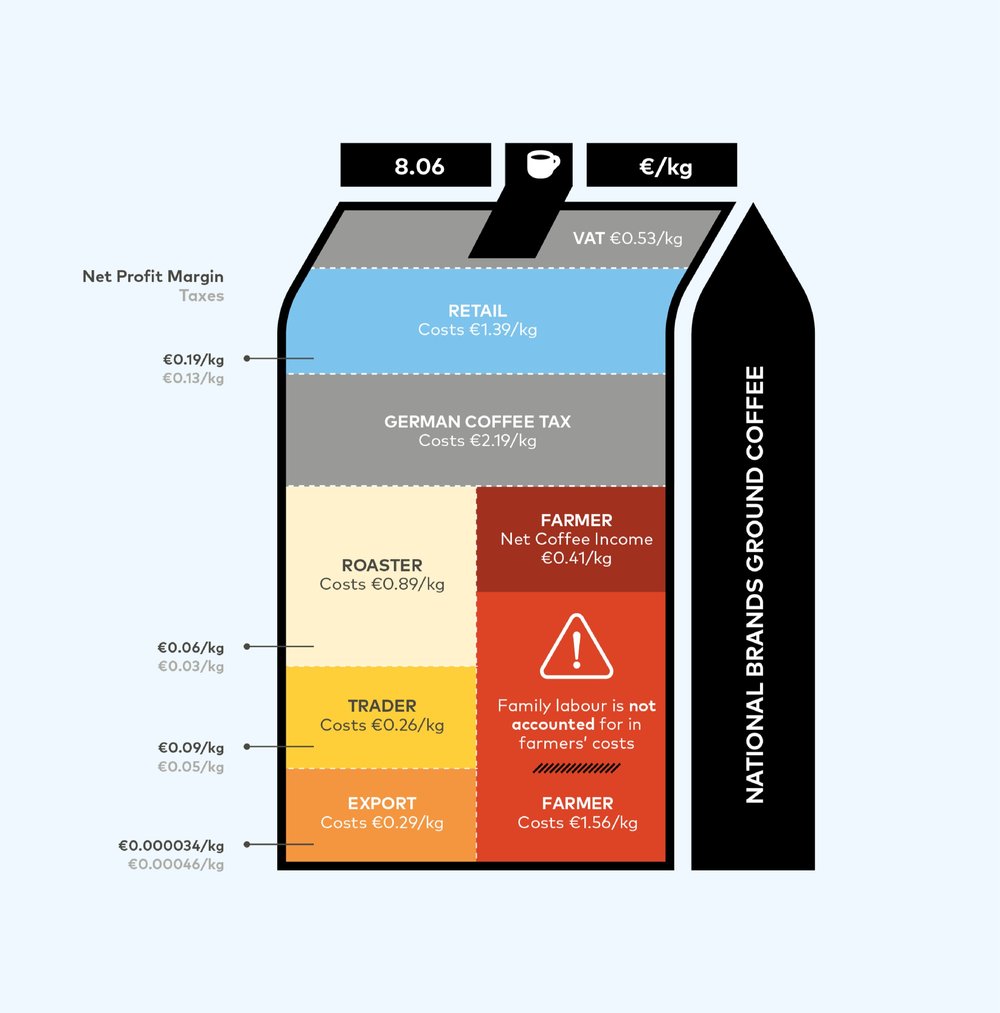
A recent analysis sheds light on the detailed cost structure of ground coffee production in Germany under national brands, where the average cost per kilogram reaches €8.06. The data reveals that taxes claim the largest share of this cost at €2.19 per kilogram, followed by retail costs amounting to €1.39 per kilogram. Meanwhile, farmers, who are at the start of the supply chain, earn a net income of only €0.41 per kilogram, highlighting a significant disparity in profit distribution across various stages of production.

The analysis also shows that roasting costs amount to €0.89 per kilogram, trading costs through intermediaries stand at €0.26, and export costs reach €0.29 per kilogram. However, the report raises concerns about farmers, pointing out that family labor is not included in agricultural cost calculations, leaving farmers to bear additional unaccounted burdens that impact their actual income.

On the other hand, the net profit margin for each kilogram stands at only €0.19, while taxes alone consume approximately €0.13 per kilogram. These figures make it evident that most financial returns are concentrated in the final stages of the production chain, while farmers receive a fraction of the earnings despite being responsible for the initial and essential stages of coffee cultivation.

These findings raise serious questions about the fairness of profit distribution in Germany’s ground coffee industry. As the burden on farmers continues to grow, compared to the returns reaped by other stakeholders in the chain, there is an urgent need for a thorough review of the revenue distribution structure. Innovative solutions are required to ensure the sustainability and equity of this critical sector, so that all contributors, especially farmers, receive a fair share that reflects their efforts in delivering coffee to consumers.

Capsules Take the Lead in Germany’s Coffee Profits Despite Smaller Market Share

The way coffee is consumed has always shaped the dynamics of its industry, and in Germany, a closer look at the 2021 market reveals a surprising story. Among the various coffee formats—ground coffee, whole beans, soft pods, and capsules—profitability varies dramatically, painting a clear picture of the industry’s current trends and challenges.

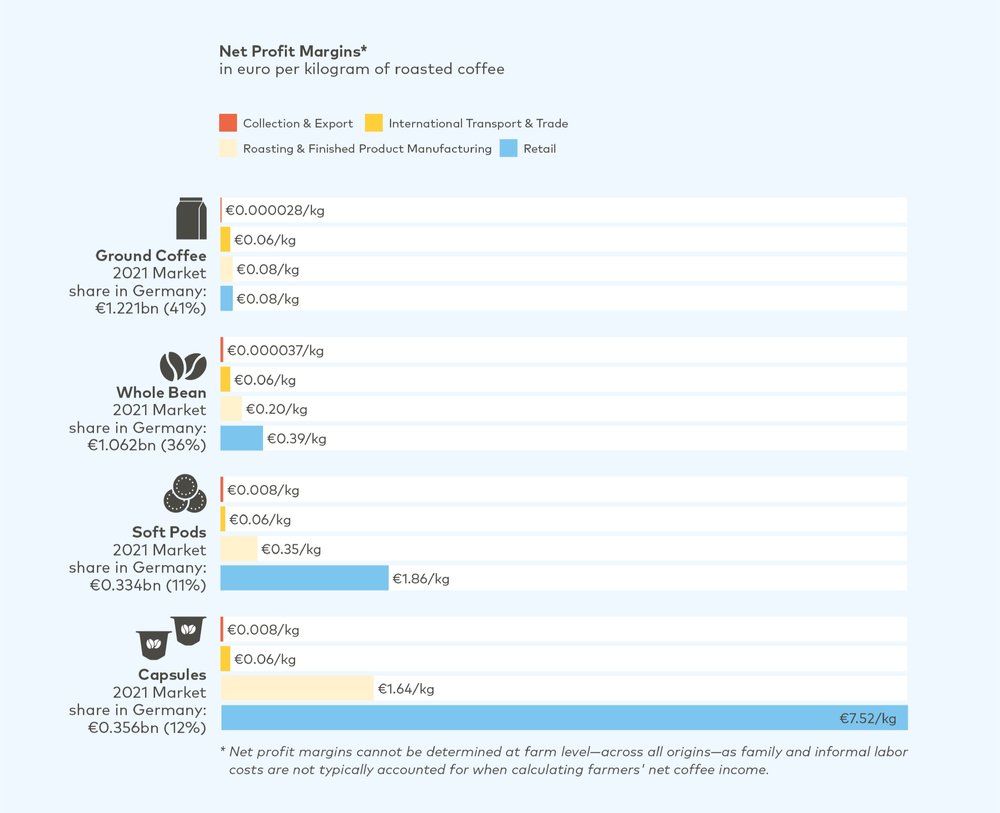
While ground coffee remains a household staple with the largest market share at 41%, its profitability tells a different tale. The net profit margins for ground coffee are a modest €0.08 per kilogram, despite its widespread popularity. On the other hand, capsules, which make up only 12% of the market, command the highest net profit margin at €7.52 per kilogram. This disparity highlights how premium pricing and consumer demand for convenience are reshaping the coffee industry.

Whole bean coffee, often favored by enthusiasts seeking freshness and quality, holds a 36% share of the market with a margin of €0.39 per kilogram. Meanwhile, soft pods, occupying 11% of the market, offer a more balanced margin of €1.86 per kilogram. Yet, none of these formats come close to the profitability of capsules, which continue to dominate the high-end segment of the coffee market.

This trend raises important questions for those involved in the coffee value chain. Farmers, who are often at the beginning of this chain, face negligible profits compared to other stages of the process. Many costs, such as family labor and informal work, are excluded from the calculations, leaving farmers with a small fraction of the final retail price. At the same time, retailers and manufacturers increasingly focus on high-margin products like capsules to stay competitive in an evolving market.

Consumers also play a pivotal role in this dynamic. Capsules are seen as a convenient and high-quality option, but their higher price point reflects their premium nature. This raises questions about sustainability, as the popularity of capsules has brought concerns over their environmental impact, particularly regarding waste and recycling challenges.

Germany’s coffee market provides a snapshot of broader global trends in coffee consumption. The numbers reveal a growing disconnect between market share and profitability, with high-margin products like capsules becoming the centerpiece of industry focus. However, this shift must be balanced with efforts to address issues like equitable income distribution for farmers and environmental sustainability. The coffee industry stands at a crossroads, with profitability driving innovation but also prompting deeper reflections on its impact across the supply chain.

Revealing the Hidden Complexities of Coffee’s Value Chain: Insights from “The Grounds for Sharing” Report

The global coffee industry, a sector valued at billions of dollars and fueled by the consumption of over 2.25 billion cups daily, is rife with challenges. Among them is the unequal distribution of value along its intricate supply chain. To address these issues, the Global Coffee Platform (GCP), IDH, and Solidaridad commissioned a groundbreaking study, The Grounds for Sharing. This report, meticulously analyzed by Mette-Marie Hansen, Senior Program Manager for Coffee at IDH, delves into the creation and distribution of value in coffee chains linked to the German retail market.

A Groundbreaking Analysis

This comprehensive study examines over 40 coffee products from Brazil, Colombia, Ethiopia, and Vietnam, tracing their journey to Germany, Europe’s largest coffee consumer. Germany’s coffee market, characterized by competitive retail dynamics and significant roasting operations, provided the ideal backdrop for this analysis. Researchers investigated conventional and certified coffees (Rainforest Alliance and Fairtrade), offering insights into the challenges of equitable value distribution.

The study highlights that coffee’s value disproportionately accumulates in the retail and roasting stages, leaving farmers with minimal financial gains. For instance, while the average retail price of coffee in Germany stands at €8.06/kg, farmers receive only €0.41/kg. This stark contrast is compounded by the undervaluation of family labor on small farms, a critical issue affecting economic stability for many growers.

Key Findings: Value Concentration and Disparities

  1. Retail Dominance: Retailers capture the largest share of profits, benefiting from branding, marketing, and premium product formats like capsules, which command higher prices but offer limited returns to farmers.
  2. Stable Margins for Exporters and Importers: These intermediaries sustain low but steady profit margins through economies of scale, ensuring efficiency in global coffee trade.
  3. Undervalued Labor: Family labor on smallholder farms is often overlooked, skewing profitability assessments and leaving farmers vulnerable to market volatility.
  4. Market Inequalities: Larger farms, particularly in Brazil, achieve greater profitability due to economies of scale, whereas smaller farms face poverty and limited opportunities to capitalize on their produce’s quality.
  5. Limited Farmer Control: Small-scale farmers often lack influence over how their coffee is marketed or sold, leaving them at the mercy of global price fluctuations and differential trading practices.

Shaping the Future of Value Distribution

The study not only sheds light on the structural imbalances in the coffee supply chain but also offers practical tools and recommendations. BASIC, the research firm behind the report, developed an online tool to simulate value and cost distribution across supply chains. This enables stakeholders to identify vulnerabilities and explore equitable solutions.

Actionable Steps:

  • Fair Compensation: Transparent pricing mechanisms that account for production costs, including family labor, are essential.
  • Collaborative Efforts: Roasters and retailers can align sourcing practices with equitable value distribution principles to support vulnerable farmers.
  • Policy and Advocacy: Governments and organizations must champion sustainable economic models for coffee farming, ensuring long-term industry viability.

Moving Beyond Awareness

While the findings validate long-standing perceptions of inequity, they also challenge misconceptions, such as the overstated profit margins of importers. The study encourages stakeholders to move beyond acknowledging the problem to implementing actionable solutions.

As Hansen aptly states, “Identifying a problem is not solving it—action is required.” By fostering equitable practices, the coffee industry can create a sustainable future that benefits all players, from smallholder farmers to end consumers.

A Call for Change

The Grounds for Sharing report serves as a wake-up call for the global coffee sector. By reevaluating value distribution and addressing systemic inequalities, the industry has the opportunity to create a fairer, more sustainable value chain. This effort requires collective action, innovation, and a commitment to empowering those at the very foundation of coffee production.

Through initiatives like this, the coffee community can ensure that every cup reflects not just the flavor of the beans but also the value of the hands that cultivated them.